
Then came the fateful day of August 6, 1990, when, under the direction of General Aslam Beg, President Ghulam Ishaq Khan dismissed a democratically elected Prime Minister and dissolved the national and provincial assemblies. President Khan exercised this authority under powers that had been conferred upon him through amendments made to the 1973 Constitution by General Zia-ul-Haq, including Article 58(2)(b), along with several other arbitrary modifications. These amendments were later ratified by the non-party assembly of 1985.
The first use of Article 58(2)(b) had been by General Zia himself on May 29, 1988, when he dismissed Prime Minister Muhammad Khan Junejo. Despite opposition from Zia, Junejo and his Minister of State for Foreign Affairs, Zain Noorani, had signed the Geneva Accord aimed at ending the Afghan jihad. Junejo’s efforts were perceived as a direct challenge to Zia’s vision of Islamic emirates in Pakistan and Afghanistan. Even before this, in 1986, Benazir Bhutto’s return to Pakistan had been facilitated without obstacles, which had already angered Zia. Consequently, Junejo was deemed deserving of punishment.
After his dismissal, Muhammad Khan Junejo quietly returned home. However, in 1991, at his residence in Karachi, he disclosed to me for the first time his reflections on the factors behind the termination of his government. At that time, Nawaz Sharif was Prime Minister. When we published Junejo’s detailed comments on Zia’s assault on his government and Sharif’s role in the split of the Muslim League, it caused a significant stir across the country, especially within Muslim League circles.
Turning to Ghulam Ishaq Khan, who hailed from the Bannu district of Khyber Pakhtunkhwa and had risen from the position of a tehsildar to the presidency, his ascent was owed to his unwavering loyalty to the military, civil bureaucracy, and Pakistan’s elite classes, along with his unconditional obedience and anti-public policies.
Even today, in Pakistani politics and corridors of power, there are individuals closely related to or aligned with Ghulam Ishaq Khan’s thinking. These include the Saifullah brothers, PTI’s senior leader Taimur Saleem Jaghra (Khan’s grandson), General Ayub Khan’s grandson and PTI leader Omar Ayub Khan, and even family connections with ANP leader Haji Ghulam Ahmed Bilour. In essence, the elite classes of Pakistan are interlinked in a web of familial and political ties that entangle the nation—a network that even Imran Khan has leveraged in his political career.
After dismissing the government in August 1990, Ghulam Ishaq Khan appointed a caretaker Prime Minister for the first time. This position went to Sindhi politician Ghulam Mustafa Jatoi, who had previously betrayed and distanced himself from Zulfikar Ali Bhutto. An election cell was established in the Presidency to manipulate the upcoming polls, and General Aslam Beg, using the ISI, distributed funds to pro-military and anti-PPP politicians and parties. The sole objective was to defeat the PPP in the elections and prevent Benazir Bhutto from returning as Prime Minister. Every conceivable unfair tactic was employed, including pre-poll rigging and on-the-day manipulation.
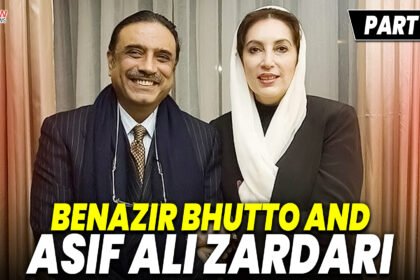
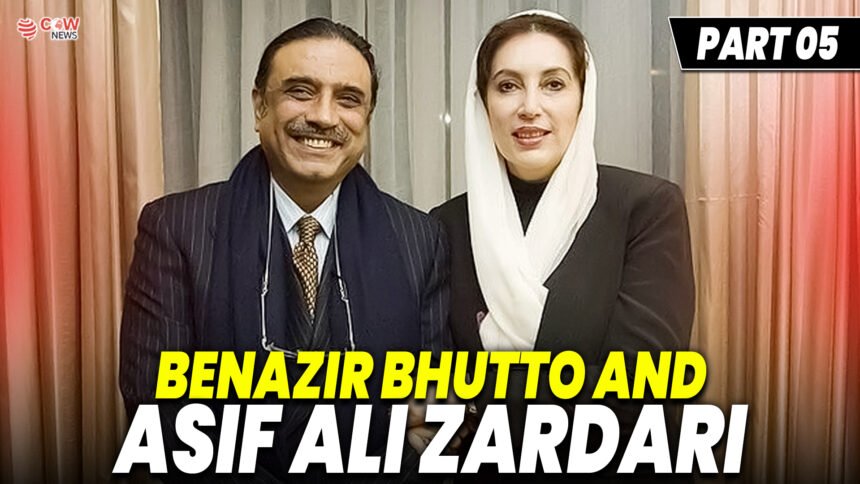
The new elections were scheduled for October 24, 1990. However, when the military and the caretaker government realized that Benazir Bhutto was conducting her campaign with renewed energy and public enthusiasm, they arrested Asif Ali Zardari only 14 days before the election. Multiple charges were filed against him, including abduction for ransom, tying a bomb to a banker’s leg, attempted murder, terrorism, and various corruption allegations. When a court granted Zardari bail, the caretaker government issued a special ordinance to revoke it.
Despite being imprisoned, Asif Ali Zardari contested the 1990 elections from Nawabshah and won, becoming a Member of the National Assembly. Even his incarceration could not end his political career.
With the support of the ISI, the rigged 1990 elections gave the IJI 106 seats out of 217 in the National Assembly, while the Pakistan Democratic Alliance (PDA), led by the PPP, secured only 44 seats. This validated the earlier prediction made by Rana Nazir Ahmad from Gujranwala. Mian Muhammad Nawaz Sharif, the Punjab Chief Minister who had washed the military’s boots and served Zia’s soldiers, was now Prime Minister of Pakistan.
Ghulam Ishaq Khan and General Aslam Beg smiled in satisfaction. General Hamid Gul could barely contain his joy as the moment had arrived to fulfill the objectives of his jihadi schemes. Bhutto’s daughter had been politically neutralized, Benazir’s protector and Bhutto’s son-in-law was imprisoned under serious charges, and the military-created savior, Mian Muhammad Nawaz Sharif, now occupied the Prime Minister’s office. Everything appeared perfectly aligned to the generals and jihadi strategists.
Yet, the military generals and the “giant” seated in the presidency, Ghulam Ishaq Khan, underestimated the man they had so eagerly elevated through rigging and manipulation. This very Mian Nawaz Sharif, whom they had installed, would eventually teach them a lesson, reminding them of their own vulnerabilities and subtly asserting his independence in ways they could never anticipate.
(To be continued.