
By Amjad Hadi Yousafzai
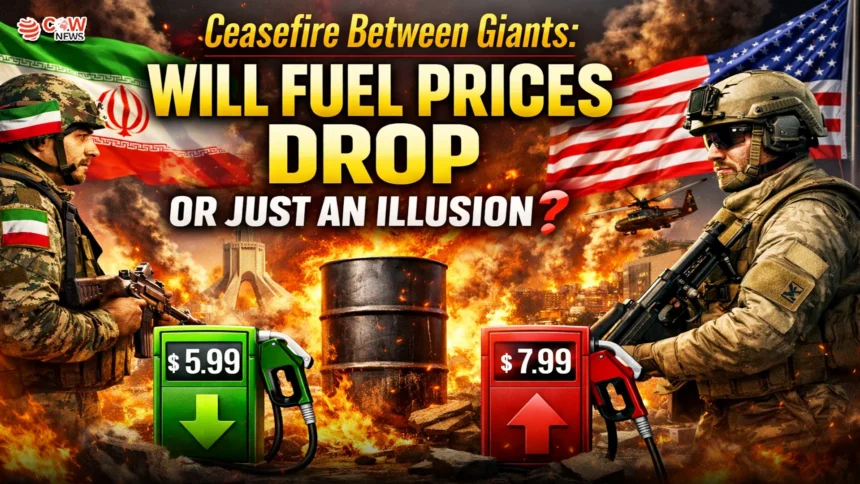
The announcement of a ceasefire between the United States and Iran has created a temporary sense of relief across an already volatile region. Markets reacted cautiously, diplomats issued carefully worded statements, and global media moved quickly to interpret what this fragile pause might mean for the future of Middle Eastern stability. Yet, in Pakistan, the reaction has been far more immediate and far more personal. The central question dominating public discussion is not about geopolitics, military strategy, or diplomatic victories. It is simple, direct, and deeply economic: will petrol become cheaper?
For ordinary citizens, international conflicts are often understood not through political analysis but through the price displayed at fuel stations. Every fluctuation in global tensions eventually finds its reflection in domestic inflation. When conflict rises, prices rise. When calm returns, expectations of relief rise even faster. This time is no different. The ceasefire has created hope, but hope in Pakistan’s economic environment is often accompanied by skepticism.
Just days before the ceasefire announcement, fuel prices were reportedly increased, adding another layer of financial pressure on households already struggling with inflation, utility bills, and stagnant incomes. The timing of these increases has fueled public frustration, with many questioning whether global oil trends are being fully or fairly passed on to domestic consumers. Now, with crude oil prices showing signs of softening in international markets, expectations of a reduction in local fuel prices have intensified.
However, history has taught Pakistani consumers to temper their optimism. Price reductions, when they occur, are often slower and less significant than price hikes. This perceived imbalance has created a trust deficit between policy announcements and public expectations. Even when global markets signal relief, domestic relief tends to arrive delayed, diluted, or sometimes not at all.
The government, for its part, has signaled that adjustments in fuel prices are under consideration. Yet there is a growing sense among citizens that announcements and implementation do not always move in sync. The delay between international price shifts and domestic relief has become a recurring theme in Pakistan’s economic narrative. As a result, the public response to any talk of price reduction is now shaped by caution rather than celebration.
Beyond the immediate issue of fuel prices, the broader geopolitical environment continues to influence Pakistan’s economic outlook. The ceasefire between the United States and Iran may be temporary, but even temporary pauses in conflict can ease pressure on global oil supply chains. Oil markets are highly sensitive to geopolitical risk, and any reduction in perceived threat tends to stabilize or slightly reduce prices. For import-dependent economies like Pakistan, even small shifts in global oil prices can have significant domestic implications.
Yet Pakistan’s economic reality is not shaped by global markets alone. Internal fiscal pressures, taxation structures, currency fluctuations, and import costs all play a role in determining final fuel prices. This complexity means that even when international prices fall, domestic relief is not guaranteed or immediate. It is this gap between global trends and local outcomes that continues to frustrate consumers.
At the same time, Pakistan’s foreign policy positioning remains a delicate balancing act. The country has consistently attempted to maintain working relationships with both Western powers and regional actors in the Middle East. This balancing act is not merely diplomatic; it has economic consequences. Stability in foreign relations often translates into stability in trade, energy imports, and financial support. However, the benefits of diplomatic engagement are not always visible in everyday life, especially when inflation remains high.
The role of Pakistan’s security establishment also remains a significant factor in maintaining internal stability during periods of external uncertainty. In times of regional tension, military preparedness and border security become critical in ensuring that domestic conditions remain stable. While such efforts may not directly influence fuel prices, they contribute to the broader environment in which economic decisions are made. Stability, or the perception of it, often plays a quiet but important role in investor confidence and currency performance.
Despite these layers of geopolitical and institutional complexity, the public conversation continues to return to a single point: affordability. For the average citizen, abstract discussions about diplomacy or security are less urgent than the immediate cost of commuting to work, running household generators, or transporting goods. Fuel prices are not just economic indicators; they are daily survival metrics.
This is why even minor changes in petrol prices become national talking points. A slight increase can trigger widespread frustration, while a potential decrease generates cautious hope. But hope, in this context, is often fragile. It is shaped by past experiences where anticipated relief did not fully materialize.
In recent years, global oil markets have experienced repeated cycles of instability. Wars, supply disruptions, production cuts, and geopolitical rivalries have all contributed to unpredictable price movements. Pakistan, as a net importer of oil, remains vulnerable to these fluctuations. While hedging strategies and regulatory adjustments are used to manage volatility, they cannot eliminate its impact entirely.
What makes the current situation particularly sensitive is the convergence of multiple pressures: a recent price hike, a fragile international ceasefire, and rising domestic inflation. Each of these factors amplifies public attention on the next fuel price announcement. It is no longer just a routine administrative update; it has become a test of economic credibility.
Economists often argue that fuel pricing should reflect global market realities while also ensuring fiscal stability. However, in practice, this balance is difficult to achieve. Governments must navigate between public relief and revenue requirements. Fuel taxes remain an important source of income, and sudden reductions in prices can affect budgetary planning. This structural dependency further complicates the possibility of immediate and significant price cuts.
For now, the expectation in Pakistan is clear: people are waiting. They are waiting not only for numbers to change at fuel stations but for a sense of fairness in how those numbers are determined. The perception that prices rise quickly but fall slowly has become deeply embedded in public sentiment.
The ceasefire between the United States and Iran may have temporarily reduced geopolitical tension, but it has not reduced domestic anxiety. If anything, it has redirected attention inward, toward governance, pricing mechanisms, and economic transparency. Citizens are asking whether global relief will translate into local relief, or whether the gap between the two will persist.
Ultimately, the question of how much petrol will become cheaper is not just about oil. It is about trust, timing, and transparency. It is about whether global developments are reflected fairly in domestic policy. And it is about whether ordinary people, already stretched by inflation, will finally experience meaningful relief or once again be told to wait.
For now, Pakistan stands at the intersection of global calm and domestic uncertainty. The ceasefire has paused one form of tension, but another continues quietly at the petrol pump. Whether this pause becomes real relief or just another temporary expectation