

By Laieq Abid Ali
Recently, as I was contemplating a subject for my next column, discussions with colleagues in the office and an assessment of ongoing provincial issues led me to an obvious choice: local government representatives. In Pakistan’s democratic history, Khyber Pakhtunkhwa (KP) stands out as the only province where local governance has been approached not merely as an administrative necessity but as a deliberate political mission. When the Pakistan Tehreek-e-Insaf (PTI) assumed power in 2013, one of their central slogans was “devolving power to the grassroots.”
The province’s current local government system is a combination of the 2013 Local Government Act and its 2019 amendments. Its structure demonstrates a careful attempt to balance accountability, participation, and administrative efficiency. The system operates on two levels: the Tehsil Council and the Village/Neighborhood Council, each serving a distinct but complementary function.
At the first level, the Tehsil Council is headed by a Mayor or Chairman who is directly elected by the public. This is a significant departure from previous systems where local heads were appointed through political maneuvering. Direct elections ensure that these officials are accountable to the people they serve, and not just to political elites or bureaucrats.
The Tehsil Council is responsible for significant administrative decisions, including budget allocations, developmental projects, and oversight of municipal services. Ideally, the Mayor or Chairman should function as a strong intermediary between provincial authorities and local communities, ensuring that governance is responsive and inclusive.
The second level comprises Village and Neighborhood Councils, the true foundation of participatory democracy. These councils are where citizens interact directly with the state. What makes them particularly remarkable is their inclusive representation: seats are reserved for women, youth, farmers, and minority groups. This inclusion ensures that all sections of society have a voice in decision-making, reinforcing the democratic principle that governance must reflect the diversity of its constituency.
In theory, this system empowers citizens, builds accountability, and encourages public participation in governance. In practice, however, its effectiveness has been hampered by structural limitations and administrative bottlenecks.
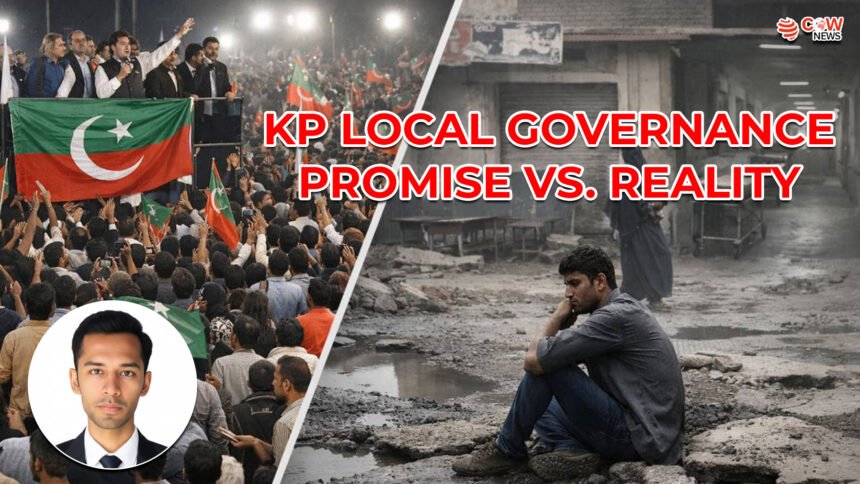
A few days ago, the streets of Peshawar bore witness to an unusual sight. Local representatives—elected to solve public problems—were themselves protesting for their funding rights. These demonstrations revealed cracks in the local government system, exposing the gap between legislated authority and practical empowerment.
One of the most pressing complaints from local representatives is financial exploitation. According to law, 30% of the provincial budget is supposed to be allocated to local government bodies. In reality, these funds are often not fully disbursed. Even when provincial authorities assert that 30% of the budget will reach the grassroots, it frequently includes amounts already spent by provincial departments such as Highways or the Public Health Engineering (PHE) department at the local level. Local representatives argue that these funds should be transferred directly to their accounts, allowing them to make decisions based on the specific needs of their constituencies.
When a Village Councilor lacks funds to repair a streetlight or clear a drainage channel, the credibility of their office suffers. This was a central grievance in the recent Peshawar protests. Despite promises from the government and the formation of oversight committees, the question remains: will these commitments ever be fully realized?
Pakistan’s power structure has historically revolved around Deputy Commissioners and Assistant Commissioners, with elected officials often playing a subordinate role. Local governance is designed to challenge this dynamic, giving elected representatives authority over matters affecting their communities. Yet, in practice, a Mayor frequently has to petition a Grade 18 or 19 bureaucrat for the release of funds.
Until true administrative authority is transferred to local representatives, the system will remain largely symbolic. Bureaucrats often argue that local representatives are incompetent, but this is often a pretext to maintain control over resources. If democratic governance is to flourish, the state must teach by empowering, not by restricting.
Despite these challenges, the local government system in KP has delivered tangible benefits. Citizens no longer need to visit provincial offices for basic services like domicile verification, and small-scale administrative tasks are now handled efficiently at the local level. However, when it comes to major development projects, citizens still face confusion and delays. The ongoing tug-of-war between Members of the Provincial Assembly (MPAs) and local representatives slows the pace of development, undermining the spirit of devolution.
Moreover, the system provides invaluable experience for youth leadership. Young councilors learning budget management today could become competent legislators tomorrow. By involving ordinary citizens in governance, the system reinforces the principle that politics is not reserved for the elite, but is a domain in which a farmer, laborer, or young professional can participate meaningfully.
If KP’s local government system is to serve as a national model, several difficult but necessary steps must be taken:
Direct Fund Allocation: Provincial funds must reach local governments based on transparent formulas like the PFC Awards, not the discretion of ministers or secretaries.
Full Administrative Devolution: Departments such as Education, Health, and Sanitation should operate entirely under local government authority.
Accountability Mechanisms: Powers should be accompanied by strict oversight to prevent corruption while allowing local representatives to function autonomously.
Institutional Transparency: Allocation of funds should follow a clear, impartial formula, leaving no room for political favoritism.
Recognition of Local Governments: Local representatives should be treated as partners, not rivals, in governance. When local councils are empowered, provincial stability improves, which in turn strengthens democracy nationally.
KP’s local government system is akin to a powerful vehicle whose engine is capable of driving meaningful change, yet is hindered by a lack of fuel (funds) and steering (authority). The recent protests in Peshawar were not just about money—they were about the dignity of local democracy.
Strengthening local governance is not merely a provincial issue; it is central to Pakistan’s democratic resilience. When democracy reaches the doorstep of the common citizen, it gains legitimacy and fosters civic trust. Weak local systems, on the other hand, breed frustration, cynicism, and disengagement.
Devolving authority to local governments also addresses larger structural inequalities. A well-funded, autonomous council can prioritize education, health, sanitation, and infrastructure, improving quality of life at the grassroots. Moreover, by involving youth, women, and minorities in decision-making, the system nurtures inclusive, future-oriented leadership.
KP’s model demonstrates that local governance can be both participatory and efficient, but only if political will aligns with administrative action. Without transparent fund transfers, full administrative control, and protection from bureaucratic interference, the system risks becoming a hollow shell—a framework on paper with little practical impact.
If KP’s model is to inspire nationwide reform, policymakers must move beyond rhetoric. Functional devolution requires:
Predictable, timely fund release: Ensuring local governments have control over allocated resources.
Clear administrative authority: Transferring decision-making powers fully to elected councils.
Robust oversight mechanisms: Balancing autonomy with accountability to prevent misuse of resources.
Public awareness and engagement: Encouraging citizens to actively participate and hold representatives accountable.
Such measures would not only empower local representatives, but also reinforce the principle that governance is a collaborative effort between the state and its citizens. When councils function effectively, provincial stability improves, and the benefits cascade to national democratic institutions.
Recent protests also highlight the political sensitivity of devolution. Local representatives are often viewed as rivals by provincial elites. This perception undermines democratic culture and stifles local governance. A progressive provincial government must recognize that empowered local representatives are allies, not adversaries, in governance. Only by treating them as partners can the state create a robust, participatory democracy.
Future Prospects
Looking ahead, KP’s local government system has enormous potential. It has already demonstrated that:
Ordinary citizens can participate meaningfully in governance.
Youth and minority groups can be integrated into decision-making.
Local solutions often outperform top-down interventions, particularly for basic services.
However, realizing this potential requires practical action, not just legislative rhetoric. Timely fund transfers, real administrative powers, and political recognition of local councils are indispensable. If these reforms are implemented, KP can emerge as a national model for democratic decentralization, illustrating how empowered local governance strengthens both provincial and national democratic institutions.
The essence of KP’s local government system lies in its ability to bring democracy to the doorstep of the common citizen. It is not enough to conduct elections and celebrate participation on paper. Real empowerment requires resources, authority, and recognition.
The recent Peshawar protests were a stark reminder that democracy cannot flourish without practical support for local representatives. Local councils are not adversaries of the state—they are its frontline, connecting citizens with governance. When streets, neighborhoods, and villages are well-managed, provincial stability improves. When the province thrives, national democracy strengthens.
In the final analysis, KP’s model is a vehicle of enormous promise. Its engine—the principle of devolved power—is powerful, but it needs fuel and direction. Provincial authorities must ensure transparent funding, full administrative control, and accountability mechanisms. Only then will local governance become a true instrument of citizen empowerment and a shining example for the rest of Pakistan.
If implemented effectively, KP’s local government system can transform political culture, nurture future leaders, and restore public faith in democratic institutions. The challenge now is simple but urgent: will the state treat local representatives as partners in governance or continue to see them as challengers to be constrained? The answer will determine the trajectory of both provincial and national democracy in Pakistan.