
By saad Akhtar Khan
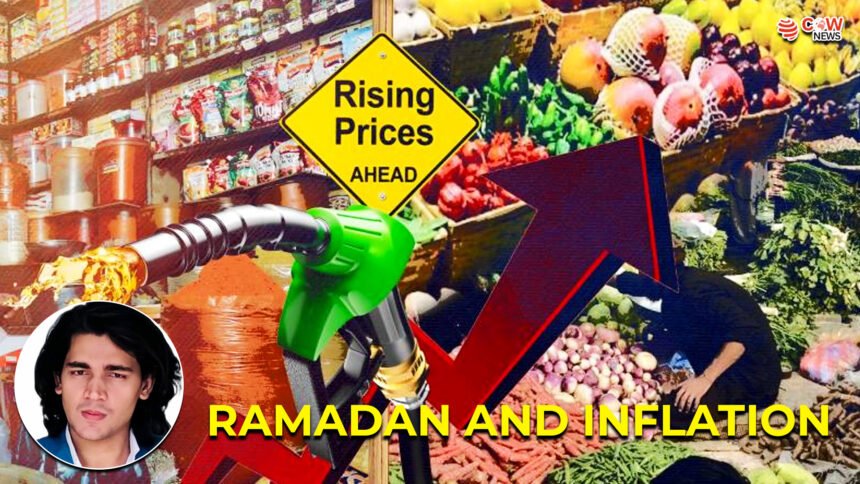
Ramadan is widely regarded as a month of spirituality, reflection, and compassion. Across the Muslim world, it is a period for fasting, prayer, charitable acts, and family bonding. It is meant to cultivate patience, empathy, self-restraint, and generosity. Yet in Pakistan, the arrival of Ramadan has increasingly come to signify something else entirely: skyrocketing prices, financial stress, and mental anguish for the common man. While the month is intended to bring mercy and reflection, for many households in Pakistan, it becomes a time of tension, worry, and economic hardship.
Almost a week before Ramadan officially begins, markets across Pakistan experience a sharp increase in activity. Streets and bazaars are crowded with shoppers, grocery stores see long queues, and the demand for staples such as flour, sugar, cooking oil, lentils, ghee, meat, and vegetables rises dramatically. This surge, however, is often not driven by actual consumption needs but by psychological fear. Consumers worry that essential goods might run out or become unaffordable, a fear that is not entirely unfounded given historical trends.
This fear creates a cyclical effect: as people buy more in anticipation of scarcity, the supply in the market temporarily shrinks, and traders take advantage by raising prices even further. What could have been a smooth seasonal adjustment transforms into panic buying, artificial shortages, and unchecked inflation. As a result, the holy month of Ramadan—intended to inspire calmness and introspection—becomes a period of financial stress.
The reasons behind this inflationary spike are multiple and interrelated. One of the most significant factors is weak government oversight. Although official price lists and regulations exist, they often remain paper exercises without enforcement. Anti-hoarding policies are inconsistently applied, and penalties for illegal practices rarely deter unscrupulous traders. In the absence of strict monitoring, some merchants exploit the high demand during Ramadan to maximize profits, disregarding both ethical and religious principles.
Another contributing factor is the role of public behavior. Panic-driven purchases, often spurred by rumors or misinformation, increase demand disproportionately. When people buy more than necessary, they inadvertently create shortages that justify further price hikes. In essence, market volatility during Ramadan is the result of a feedback loop: public anxiety drives consumption spikes, and traders exploit the situation for extra gains.
The effects of Ramadan inflation are felt most acutely by low-income households and daily wage earners. Even minor increases in the price of essential commodities like flour, sugar, or cooking oil can push these families into financial distress. Ramadan, a month that ideally should offer spiritual solace, becomes a time of stress and anxiety. Families that would otherwise focus on prayer, reflection, and charitable deeds find themselves preoccupied with basic survival: How will they afford sehri and iftar? Which items can they buy without stretching their already limited budget?
For many, the psychological burden is immense. While upper-income families may absorb price hikes without significant hardship, the poorest segments of society are forced to compromise on nutrition, quality, and quantity. Children often bear the brunt of this stress, with families making difficult choices about what to feed them during fasting hours. Thus, a month designed to encourage empathy and solidarity paradoxically exacerbates social inequality.
Beyond economics, Ramadan inflation raises profound ethical and moral questions. Islam emphasizes honesty in trade, fairness in pricing, protection of the vulnerable, and the ethical treatment of others. Profiteering during Ramadan is more than a market distortion—it is a direct violation of these religious principles. When traders inflate prices during a month devoted to mercy and compassion, the sacred essence of Ramadan is compromised.
Ethical lapses in commerce during Ramadan do more than harm individual families—they corrode societal cohesion. When one segment of society exploits others during a period meant to cultivate solidarity, it deepens social divides. This moral crisis is as significant as the financial one, underscoring the need for both institutional and individual reform.
Commercialization of Ramadan has also played a significant role in intensifying inflationary pressures. Weeks before the holy month begins, media campaigns promote “Ramadan offers,” discounts, and special deals. While these advertisements may be designed to attract shoppers, they have a subtle but powerful effect on public psychology: they create a perception that more consumption equates to better preparation for the month.
The combination of mass advertising and cultural expectations fuels unnecessary buying. Consumers start purchasing not out of need, but out of fear of missing out or falling behind societal norms. Retailers, in turn, respond to this heightened demand by raising prices. This cycle—media-driven desire, consumer overbuying, and price inflation—turns a spiritually significant month into a commercialized frenzy.
While government authorities often announce policies to control inflation, implementation remains weak. Price regulation, market monitoring, and enforcement against hoarding are rarely comprehensive. Penalties for violations exist in theory, but in practice, they are insufficient to deter unscrupulous actors. Without a robust and transparent system, traders continue to exploit the season, knowing the risks are minimal.
Some experts argue that Ramadan inflation in Pakistan is not a mere coincidence but a structural issue tied to broader economic mismanagement. Supply chains, import dependencies, and logistical inefficiencies all contribute to shortages. Without addressing these systemic problems, any short-term measures—such as temporary price controls—offer only fleeting relief.
Addressing Ramadan inflation requires more than government intervention; it requires a shift in public mindset. Consumers must recognize the difference between needs and wants, and resist panic-driven purchasing. Religious leaders, media outlets, educational institutions, and civil society can play pivotal roles in promoting moderation, ethical consumption, and community responsibility.
If households embraced simplicity, avoided unnecessary stockpiling, and focused on essential needs, the pressure on markets would diminish. Traders would have less opportunity to exploit panic buying, and prices would stabilize. In this sense, collective behavioral reform is as crucial as regulatory enforcement.
Ramadan is not only a month of worship; it is a comprehensive system of moral and social reform. Its teachings extend beyond fasting and prayer to include self-discipline, empathy, and ethical behavior. By internalizing these principles, society can influence economic behavior positively.
For example, adopting simpler iftar practices, resisting indulgence in luxury items, and prioritizing charity over consumption can reduce unnecessary financial stress. Schools and religious institutions can educate younger generations on the spiritual and social significance of moderation. Over time, these efforts can cultivate a culture that balances tradition with responsibility, easing economic pressures during the holy month.
Historical data shows that Ramadan inflation is not unique to Pakistan, but the scale and severity differ. In countries with strong regulatory frameworks, such as Malaysia or Turkey, seasonal price increases are relatively moderate due to strict market oversight and consumer awareness. In Pakistan, however, repeated cycles of panic buying, hoarding, and speculative price increases indicate systemic vulnerabilities.
Past efforts to curb inflation have included temporary subsidies, price ceilings, and market monitoring committees. While these initiatives sometimes provide short-term relief, they fail to address the root causes: weak enforcement, public panic, and cultural acceptance of profiteering. A comprehensive approach that combines regulation, public education, and ethical accountability is essential for meaningful change.
Beyond immediate concerns, addressing Ramadan inflation presents an opportunity for broader societal reform. If the lessons of moderation, empathy, and fairness that Ramadan teaches are applied consistently throughout the year, the benefits extend far beyond the holy month. Ethical business practices, equitable distribution of resources, and conscious consumption can strengthen social cohesion, reduce inequality, and create a more resilient economy.
In this sense, Ramadan is not merely a religious obligation but a blueprint for societal well-being. By internalizing its principles, Pakistan could reduce seasonal inflation, alleviate pressure on low-income families, and foster a culture of fairness and compassion.
The media has a dual role in this scenario. On one hand, it can amplify consumerist behavior through excessive promotion of discounts and offers. On the other, it has the power to educate, inform, and guide public behavior. Media campaigns can encourage moderation, highlight ethical consumption, and provide practical tips for families to manage Ramadan expenses effectively. When harnessed responsibly, media becomes a tool for social reform rather than a catalyst for panic-driven consumption.
Ramadan in Pakistan highlights a striking paradox. A month meant for spiritual reflection and moral upliftment is often overshadowed by financial stress, ethical lapses, and social tension. Inflation during Ramadan is not merely an economic phenomenon; it is a reflection of deeper structural, social, and moral challenges.
Addressing this issue requires a multi-pronged approach. Government authorities must enforce regulations rigorously, implement transparent monitoring systems, and impose meaningful penalties for hoarding and profiteering. Simultaneously, the public must embrace moderation, resist panic buying, and internalize the ethical lessons of Ramadan. Religious and educational institutions, along with media platforms, have crucial roles in shaping public perception and behavior.
Ultimately, the true message of Ramadan—simplicity, sacrifice, compassion, and service to others—offers a path not only for spiritual renewal but also for social and economic reform. If society embraces this ethos, the holy month can once again become a period of reflection, peace, and communal harmony rather than financial distress and anxiety.
Ramadan’s lesson is timeless: when morality, moderation, and empathy guide behavior, even complex challenges like inflation can be mitigated. By internalizing these principles, Pakistan can restore both the spiritual essence of the holy month and the financial well-being of its people.