

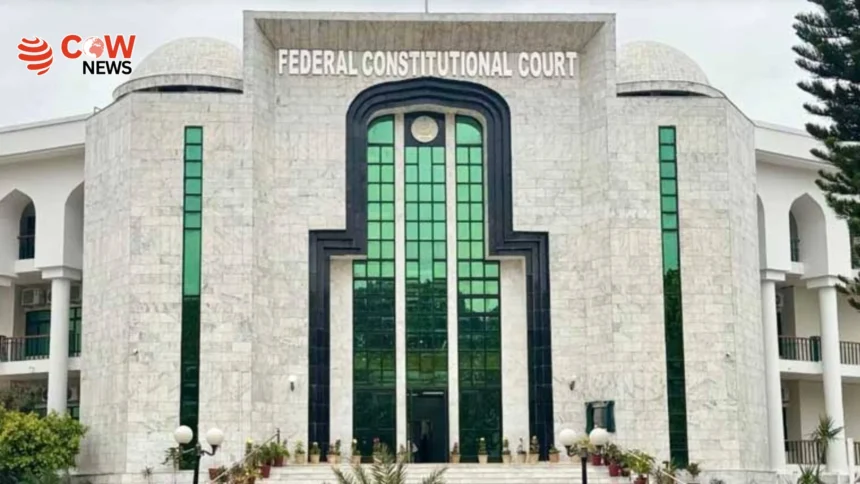
Pakistan ( The cow news digital ) Federal Constitutional Court of Pakistan has issued a significant ruling clarifying the legal and religious status of marriages involving Muslim men and women from the “People of the Book,” including Christians.
In its decision, the court stated that, under Islamic law, Muslim men are permitted to marry women belonging to the أهلِ کتاب (People of the Book). The ruling came during the hearing of a case involving the marriage of a Christian minor girl to a Muslim man, raising broader legal and constitutional questions.
The court further observed that under the Child Marriage Restraint Act 1929, underage marriages may result in criminal penalties but do not automatically render the marriage invalid. It noted that the law prescribes punishment for those involved but does not explicitly declare such marriages void.
During the proceedings, the court upheld the marriage of Maria Bibi, ruling that she had voluntarily converted to Islam prior to her marriage. The bench emphasized that her declaration of conversion was on record and that she had clearly stated before a magistrate that she entered into the marriage of her own free will, without coercion.
The court also addressed procedural aspects, stating that questions related to the authenticity of religious documents or the age of the individual could not be fully examined within the scope of a habeas corpus petition. It added that such petitions are limited in scope and cannot be used to re-evaluate all evidentiary aspects of a case.
In a broader constitutional interpretation, the court declared itself the final authority on constitutional matters, asserting that even the Supreme Court of Pakistan is bound to follow its rulings in such cases. It further stated that it is not obligated to follow precedents set by the Supreme Court if they conflict with constitutional provisions or statutory law.
The case originated in Lahore, where Maria Bibi had married a man named Shehryar after converting to Islam. Her father had initially filed a kidnapping case in 2015, which was later dismissed. Subsequent petitions alleging unlawful detention based on her age were also rejected by various courts, including the constitutional court.
The ruling also pointed out inconsistencies in the father’s statements regarding his daughter’s age, noting discrepancies between claims made in the FIR and later legal arguments. Additionally, official records raised doubts about the accuracy of the age-related claims.
The court concluded that the marriage was valid under the circumstances presented and reaffirmed the importance of individual consent in such matters.