

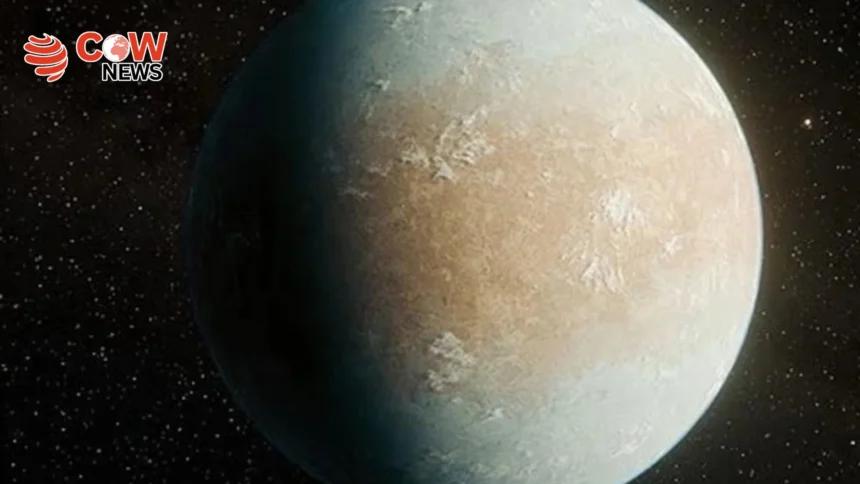
Islamabad(The COW News Digital)NASA scientists have announced the discovery of a potentially Earth-like exoplanet located around 146 light-years away from our planet, raising fresh hopes in the search for worlds capable of supporting life beyond the solar system.
The newly identified planet, named HD 137010 b, is believed to be a rocky exoplanet orbiting a star similar to the Sun. According to NASA, the planet may lie on the outer edge of its star’s so-called habitable zone—the region where conditions could allow liquid water to exist on the surface, a key ingredient for life as we know it.
HD 137010 b revolves around a host star known as HD 137010, which scientists describe as cooler and dimmer than Earth’s Sun. Due to the star’s lower energy output, the surface temperature of the planet is estimated to be relatively low. NASA researchers suggest the planet’s temperature may not exceed -90°F (-68°C). For comparison, Mars—often considered Earth’s closest planetary neighbor in terms of exploration—has an average surface temperature of around -85°F (-65°C).
Despite its cold environment, scientists stress that the planet’s location within the habitable zone makes it scientifically significant. Even at the outer edge of this zone, conditions could allow for subsurface water or temporary liquid water under the right atmospheric circumstances.
The discovery was made using data from NASA’s Kepler Space Telescope, one of the most successful missions dedicated to finding planets outside our solar system. HD 137010 b was detected through a single transit event, a method that involves observing a slight dimming of a star’s light when a planet passes in front of it. This observation occurred during Kepler’s extended K2 mission, which continued planet-hunting operations after the spacecraft lost some of its original functionality.
NASA scientists note that while a single transit limits the amount of information available, the planet’s size, orbital position, and rocky nature make it a strong candidate for future study. Follow-up observations using next-generation telescopes could help determine whether HD 137010 b possesses an atmosphere and what its chemical composition might be.
The discovery adds to a growing list of exoplanets that suggest Earth-like worlds may be more common in the universe than once believed, bringing scientists one step closer to answering the age-old question: are we alone?