

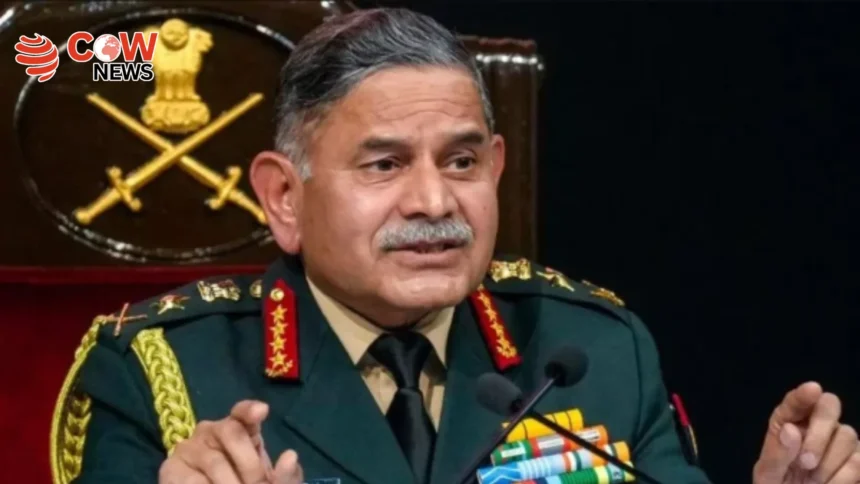
Delhi(The COW News Digital)In a rare admission, Indian Army Chief General Upendra Dwivedi has acknowledged that during Operation Sandor, Pakistan had detailed intelligence on Indian military deployments, including the locations of aircraft, planes, and key units.
Speaking at a press conference in New Delhi, General Dwivedi highlighted Pakistan’s comprehensive monitoring capabilities, noting that Islamabad possessed precise satellite data that allowed it to track Indian troop movements in real time. “Pakistan knew exactly where each of our aircraft, planes, and units were positioned,” he stated, according to reports by the ANI news agency.
Read More:
- Curfew Imposed in Nepal After Mosque Attack Sparks Unrest
- UK and France Agree on Troop Deployment for Ukraine
The revelation comes amid longstanding tensions between the two nuclear-armed neighbors, where strategic and technological advancements on both sides are closely watched. Analysts suggest that the acknowledgment underscores the critical role of satellite intelligence in modern military operations and the ongoing regional security dilemma.
While General Dwivedi criticized Pakistan’s military strategies during his remarks, the admission that Pakistan had full satellite visibility of Indian forces marks a significant disclosure from a top Indian military official. Experts note that such surveillance capabilities can provide a substantial tactical advantage during conflicts, allowing a country to anticipate movements, plan countermeasures, and respond swiftly to emerging threats.
The Indian Army Chief also emphasized the need for India to develop robust defense systems, including missile forces, citing Pakistan and China as examples. “Pakistan and China have already established their rocket forces. India must also strengthen its missile capabilities in a similar manner,” he remarked. This statement signals India’s focus on enhancing its strategic deterrence in the region.
Military analysts believe that the acknowledgment may spark renewed debates in India regarding national security, satellite intelligence infrastructure, and preparedness for potential future conflicts with neighboring countries. Meanwhile, observers point out that transparent discussions about intelligence capabilities are rare in South Asia, making this admission particularly notable.
As both nations continue to modernize their military forces and expand technological capabilities, such disclosures highlight the increasingly sophisticated nature of regional security dynamics. Strategic experts warn that satellite surveillance and real-time monitoring could significantly influence future military engagements between India and Pakistan.