
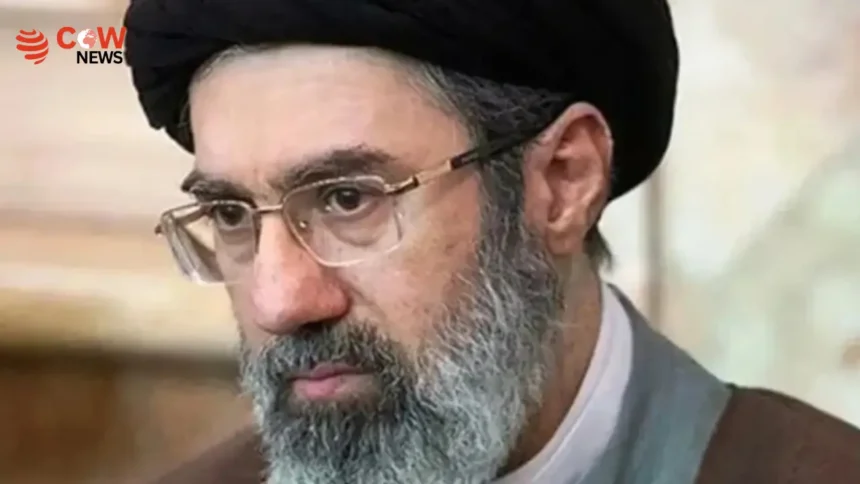
Iran(The COW News Digital)A major political transition has taken place in Iran as Mojtaba Khamenei has been appointed the country’s new Supreme Leader following the reported death of Ali Khamenei after recent military attacks involving United States and Israel, according to Iranian state media.
The decision was made by the Assembly of Experts, Iran’s powerful clerical body responsible for selecting the country’s Supreme Leader. The 88-member council reportedly voted with a strong majority to elevate Mojtaba Khamenei to the highest political and religious authority in the Islamic Republic.
With this appointment, Mojtaba Khamenei becomes the third Supreme Leader in Iran’s history, following Ruhollah Khomeini, the founder of the Islamic Republic, and his successor Ali Khamenei, who led the country for decades.
State media reported that the decision was formally confirmed after consultations among senior clerics and political leadership. The Assembly of Experts concluded that Mojtaba Khamenei would assume the role of Supreme Leader and take responsibility for guiding the nation during a period of heightened regional tensions.
Mojtaba Khamenei is considered a mid-ranking cleric within Iran’s religious establishment. Despite maintaining a relatively low public profile over the years, he has long been viewed by political observers as a potential successor to his father due to his close connections with influential institutions within the Iranian system.
Analysts have frequently pointed to his strong ties with the Islamic Revolutionary Guard Corps (IRGC), one of the most powerful military and political forces in Iran. These relationships have been seen as a key factor that helped consolidate support for his leadership among influential circles within the country.
Reports suggest that sections of Iran’s political elite had already been considering Mojtaba Khamenei as a viable candidate for the position in recent years. Support from networks associated with the office of the Supreme Leader and other centers of influence reportedly strengthened his path to leadership.
However, some political commentators note that Iran’s revolutionary ideology traditionally discourages hereditary succession in leadership. The appointment of the Supreme Leader’s son has therefore sparked debate among analysts about the evolving nature of power dynamics within the Islamic Republic.
Despite these debates, officials say the transition is intended to ensure political continuity and stability at a time when Iran faces significant external pressure and regional uncertainty.
Observers across the Middle East are now closely watching how Mojtaba Khamenei will shape Iran’s domestic policies and foreign relations as he steps into one of the most powerful positions in the region.