

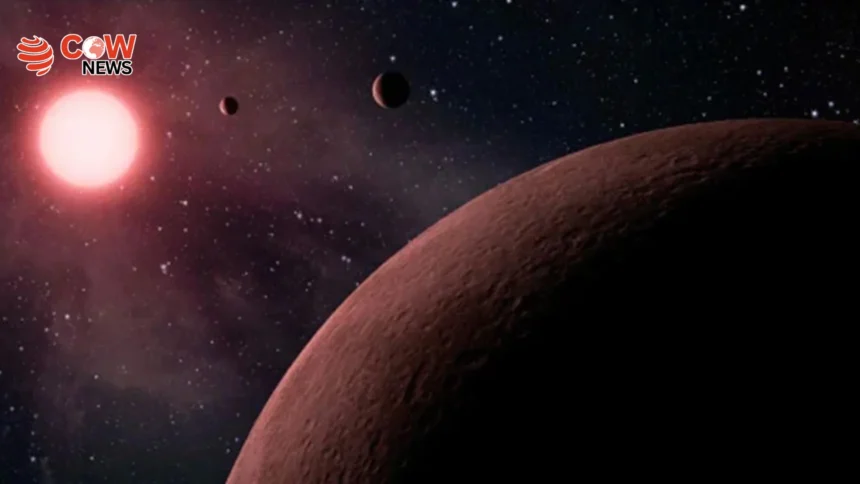
New York ( The cow news digital ) Scientists have announced the discovery of a remarkable new exoplanet, L 98-59 d, which appears to be unlike any previously studied world. The planet is believed to host a vast, permanent ocean of magma and an atmosphere rich in sulfur-based compounds.
Located approximately 35 light-years away from Earth, the planet orbits a nearby star and has drawn significant attention from the scientific community due to its unusual composition. The discovery was made possible through observations conducted using the advanced James Webb Space Telescope, which has enabled researchers to study distant worlds in unprecedented detail.
According to researchers, L 98-59 d is about 1.6 times the size of Earth, placing it in the category of super-Earths. However, its environmental conditions set it apart. The planet’s atmosphere contains high levels of hydrogen sulfide, a gas commonly associated with sulfur-rich environments, suggesting a chemically extreme and hostile setting.
Earlier theories about the planet varied widely. Some scientists believed it might be a gas dwarf with a thick hydrogen envelope, while others speculated it could be an ocean world covered in deep layers of water and ice. However, the latest findings have ruled out these possibilities, pointing instead to a new class of planetary bodies dominated by heavy sulfur compounds and molten surfaces.
read more
- China Urges Global Support for Sustainable Sudan Solution
- US Envoy Backs Israel’s Claim to Wider Middle East
The presence of a continuous magma ocean indicates intense geological activity, likely driven by extreme internal heat and close proximity to its host star. Such conditions would make the planet uninhabitable by known life forms, but they offer valuable insights into planetary formation and evolution.
Experts believe this discovery could significantly expand our understanding of the diversity of planets in the universe. It also highlights the role of next-generation space telescopes in uncovering previously hidden characteristics of distant celestial objects.
Researchers emphasize that further study of L 98-59 d may reveal additional details about its structure, atmosphere, and origin, potentially reshaping current models of planetary science.
This finding opens new avenues for exploring exotic worlds and underscores how much remains unknown about the universe beyond our solar system.