
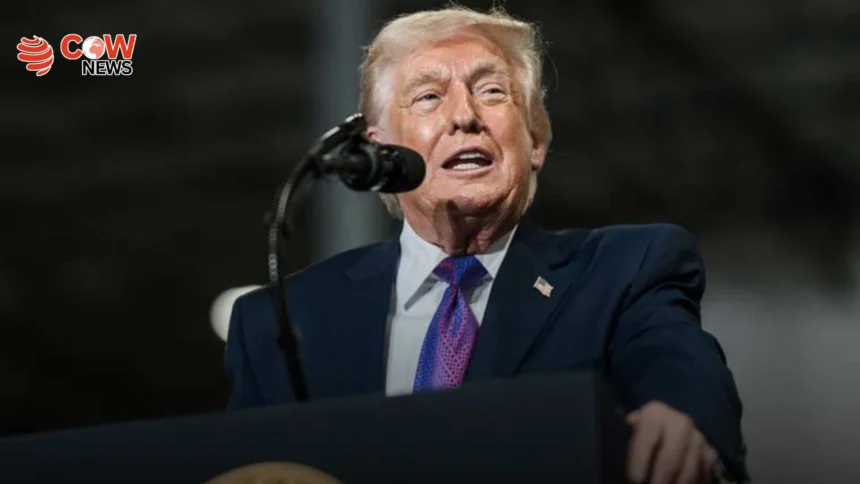
World ( The cow news digital ) WASHINGTON: United States President Donald Trump has claimed that Iran is interested in reaching a diplomatic agreement with the United States but is hesitant to speak openly due to internal and external pressures.
Addressing a Republican Party convention, Trump stated that Iranian leadership “strongly desires” a deal but fears the consequences of public acknowledgment. According to him, the situation inside Iran is so sensitive that officials are worried about backlash from their own people if they openly support negotiations.
Trump further asserted that the United States has played a major role in preventing global conflicts, claiming that Washington has helped stop eight wars around the world. He also added that the country is currently “winning one war,” without specifying further details.
The former president said that Iran’s leadership is caught between political survival and international diplomacy. He argued that Iranian officials are concerned that failure to reach an agreement could lead to severe consequences, while even discussing a deal publicly could create internal instability.
His remarks come amid ongoing tensions between Washington and Tehran over nuclear development, sanctions, and regional security issues. Relations between the two countries have remained strained for years, with intermittent diplomatic efforts failing to produce a long-term agreement.
read more
- US Envoy Backs Israel’s Claim to Wider Middle East
- Pakistan, Taliban, and Afghanistan: The Complex Triangle of Influence
Trump also used the platform to highlight his administration’s foreign policy record, claiming that his leadership had contributed to global stability by preventing multiple conflicts from escalating. He reiterated his stance that strong U.S. pressure is necessary to bring adversaries to the negotiating table.
Political analysts note that such statements are part of Trump’s broader campaign narrative, emphasizing strength in foreign policy and contrasting his approach with previous administrations. However, critics argue that his claims often lack detailed evidence and oversimplify complex geopolitical situations.
Meanwhile, international observers continue to stress that the Iran issue remains highly sensitive, with negotiations influenced by multiple regional and global stakeholders. Any potential agreement would likely require careful diplomacy and long-term commitments from all sides.
As the political rhetoric intensifies in the United States, the future of U.S.–Iran relations remains uncertain, with both diplomatic channels and strategic tensions continuing in parallel.