
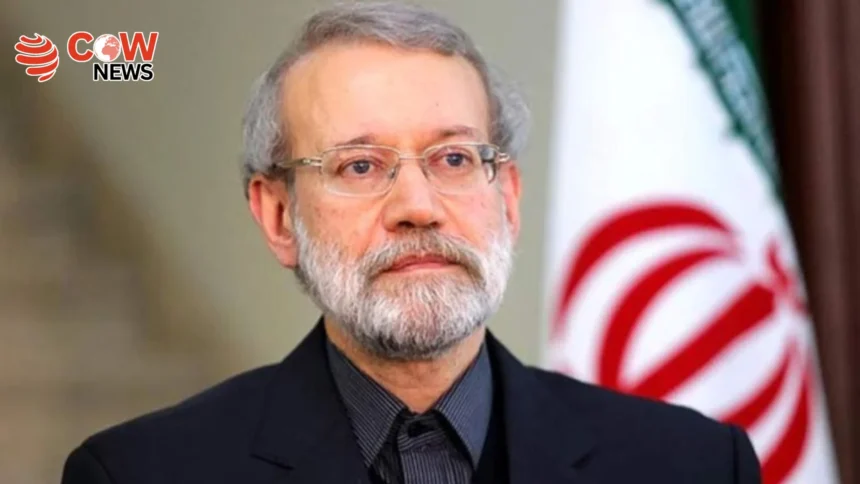
Tehran (The COW News Digital) Iran has declared the armed forces of certain European countries as “terrorist organizations” in response to recent European Union actions against the Islamic Revolutionary Guard Corps (IRGC). The announcement came from Ali Larijani, Secretary of Iran’s Supreme National Security Council, following the EU’s decision to designate the IRGC as a terrorist entity.
In a statement, Larijani said that all countries participating in the EU’s resolution against the IRGC would have their forces regarded as terrorist organizations under Iranian law. “The responsibility for the consequences of this action lies with the European countries that made such decisions,” he added.
Iran’s parliament approved legislation in April 2019 concerning the IRGC, which, according to Iranian media, allows the designation of foreign actors targeting the IRGC as terrorists. Larijani emphasized that the European Union is fully aware of Iran’s domestic laws, which provide a legal framework for Tehran’s response to foreign sanctions or resolutions affecting the IRGC.
The EU’s move came just one day prior, when European member states formally labeled the IRGC a terrorist organization. Iran’s armed forces condemned the designation, describing it as “illogical, irresponsible, and malicious.” The announcement triggered heightened rhetoric from Tehran against European governments, underscoring the growing diplomatic tension between Iran and the West.
The IRGC is a central component of Iran’s military apparatus, established following the 1979 Iranian Revolution. The organization operates alongside the regular Iranian military and reports directly to Iran’s Supreme Leader, Ayatollah Ali Khamenei. It plays a pivotal role in both internal security and Iran’s regional operations.
Analysts say that Iran’s designation of European forces could escalate political tensions and complicate diplomatic engagement between Tehran and the European Union. Observers note that the move could have repercussions for military cooperation, trade, and regional security negotiations.
While the EU and its member states justify the IRGC designation on grounds of regional security concerns, Iran’s response highlights the increasing polarization in international relations surrounding military and paramilitary organizations in the Middle East.
The situation underscores the challenges of balancing international law, domestic legislation, and geopolitical interests in the context of growing tensions between Iran and Western powers.