

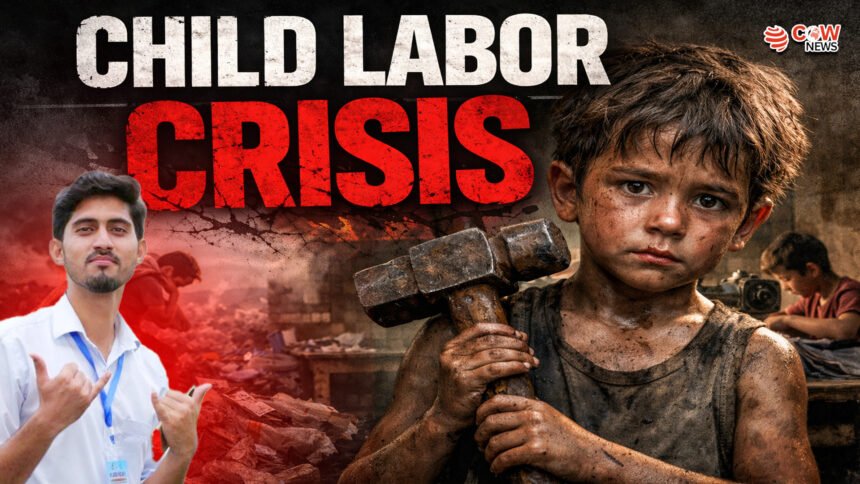
Child labor remains one of the most pressing social challenges in Khyber Pakhtunkhwa (KP), Pakistan, affecting hundreds of thousands of children across the province. While the issue is not new, recent data and field observations indicate that it continues to grow in scale and severity, threatening not only the immediate well-being of children but also the long-term socio-economic future of the region. Children who should be in classrooms, acquiring knowledge and skills, are instead engaged in markets, factories, workshops, agricultural fields, and other physically demanding jobs. These children are forced to shoulder responsibilities far beyond their age, often at the expense of their health, education, and mental development.
The consequences of child labor extend beyond the economic sphere; they strike at the very fabric of human development. Education, a cornerstone for personal growth and societal progress, is frequently the first casualty. When children are deprived of schooling, their cognitive and social development suffers. Without foundational learning, these young individuals are likely to face limited career opportunities, reduced earning potential, and diminished ability to participate fully in society. In other words, child labor today creates a cycle of poverty, limiting the next generation’s capacity to break free from socio-economic marginalization.
Health and safety are also critical concerns. Children engaged in physically demanding work are at higher risk of injuries, chronic illnesses, and long-term physical disabilities. Exposure to hazardous environments—ranging from agricultural machinery to chemical-laden workshops—compounds these risks. Mental health is equally affected. The psychological stress of long working hours, combined with the absence of a nurturing environment, often results in anxiety, depression, and behavioral challenges. In severe cases, children may resort to self-harm or other destructive coping mechanisms due to overwhelming pressure.
Statistics paint a stark picture. According to a survey by the KP Department of Labor, in 2024, the province had approximately 8.28 million children aged 5 to 17 years. Among them, around 11.1 percent—roughly 922,314 children—were engaged in labor. Of these, 745,000 were classified as child laborers under formal definitions, and an alarming 73.8 percent were employed in hazardous or physically demanding work. The sectors that employed the largest number of child laborers included agriculture, retail, hospitality, and other manual labor-intensive industries. Notably, this data underscores the link between economic necessity and child labor: children from low-income households are frequently forced into work to supplement their families’ meager incomes.
By 2025, reports indicate that the number of children trapped in labor remained nearly the same, with an estimated 745,000 children still working under conditions detrimental to their development. Boys were the majority among child laborers, and the highest concentrations were reported in districts such as Bannu and Lower Dir. Many of these children continue to work long hours in fields, workshops, and other labor-intensive environments, where the physical and psychological risks remain severe. The persistence of these numbers highlights a troubling fact: despite government policies and awareness campaigns, child labor has not decreased and remains a critical social problem.
Poverty is the primary driver of child labor in KP. Families with limited resources often depend on children to contribute to household income. For many households, sending children to work is not a choice but a necessity. Access to schools is another major barrier. In remote and rural areas, the absence of educational infrastructure, coupled with a lack of awareness among parents about the importance of schooling, pushes children into labor. Even where schools exist, quality of education and retention rates may be low, prompting families to prioritize immediate economic survival over long-term educational goals.
The types of work children are involved in vary widely but are often arduous and hazardous. Agricultural work, domestic labor, commercial work, and even small-scale industrial tasks expose children to long working hours, extreme physical demands, and unsafe conditions. In many cases, children perform repetitive, labor-intensive tasks that hinder their physical development and increase the likelihood of injuries. These environments also limit opportunities for socialization, play, and creative growth—activities crucial for balanced childhood development.
Child labor’s impact on education cannot be overstated. With roughly 4.9 million children out of school in KP, the majority are at risk of a lifelong cycle of limited opportunities. Education deprivation not only affects individual prospects but also has broader social implications. A society with large numbers of uneducated children faces challenges in achieving economic development, social cohesion, and political stability. Children denied education are less likely to develop critical thinking skills, leadership qualities, and professional competencies, which are essential for nation-building.
Health repercussions of child labor are severe and multifaceted. Physically, children engaged in manual labor often experience stunted growth, chronic fatigue, musculoskeletal injuries, and exposure to environmental hazards. Mentally, prolonged work-related stress, lack of recreational opportunities, and absence of nurturing support contribute to anxiety, low self-esteem, and behavioral disorders. These combined effects not only diminish quality of life in childhood but also increase vulnerability to health issues in adulthood. The psychological burden of child labor can be long-lasting, shaping personality development and social behavior for years to come.
Recognizing the gravity of the problem, the KP government approved a Child Labour Action Plan aimed at mitigating the crisis. The plan outlines multiple interventions, including restructuring child labor enforcement units, introducing welfare schemes for children, providing financial assistance to parents, and promoting school enrollment. While these measures represent a positive policy framework, practical implementation remains limited, and real change requires sustained commitment, community engagement, and effective monitoring.
The societal dimension of child labor must also be acknowledged. It is not solely the responsibility of parents or government authorities to tackle the problem. Civil society, media organizations, educational institutions, and religious groups all have a role to play in raising awareness, advocating for children’s rights, and creating safe spaces for learning and play. Public consciousness is vital to pressure institutions to enforce laws and ensure compliance. Only through a collective effort can the entrenched practices of child labor be dismantled.
Creating an environment where every child can attend school, play, and grow safely is essential for both individual and national development. Access to quality education, economic support for vulnerable families, and safe, engaging spaces for children are non-negotiable elements for a prosperous society. When children are forced into labor, the nation loses not just their potential but also the opportunity to cultivate a skilled, innovative, and healthy workforce for the future.
Moreover, the ethical implications of child labor demand urgent attention. Exploiting a child’s labor undermines their fundamental rights and erodes social justice. Every child deserves to enjoy their formative years, free from the burden of adult responsibilities. Childhood is not merely a phase of life but the foundation upon which a productive and fulfilled adult life is built. Denying this foundational period due to economic pressures is not just a social failing—it is a moral crisis.
The consequences of ignoring child labor extend beyond the individual to society at large. Children forced into labor today are likely to become undereducated adults tomorrow, limiting the overall human capital of the region. Social inequalities are perpetuated, and economic growth is constrained by a workforce that lacks essential skills. Furthermore, communities with high child labor prevalence often experience increased social tension, lower productivity, and diminished civic participation, creating a cycle of deprivation and marginalization.
Concrete steps are essential to reverse this trend. Expanding access to quality education is paramount, particularly in remote and underserved regions. Financial incentives and support programs for families can reduce reliance on child labor as a survival strategy. Enforcement of labor laws and regular inspections of workplaces are necessary to identify and prevent illegal child employment. Equally important is the cultivation of societal awareness, encouraging local communities to recognize the dangers of child labor and actively participate in protective measures.
Media campaigns, public seminars, and educational workshops can reinforce the message that children belong in schools and playgrounds, not labor markets. Collaboration between government agencies, NGOs, and local leaders can ensure that child labor eradication programs are responsive to the unique challenges of each district. Special focus must be given to areas like Bannu and Lower Dir, where the concentration of child labor remains alarmingly high.
Ultimately, safeguarding children from labor exploitation is an investment in the nation’s future. Every child prevented from entering the labor force prematurely represents a potential professional, innovator, or leader in the making. Their education, health, and well-being are inextricably linked to the country’s economic and social prosperity. Ignoring this reality risks perpetuating cycles of poverty and underdevelopment, while proactive intervention can transform the trajectory of countless lives.
In conclusion, child labor in Khyber Pakhtunkhwa is not merely a statistical concern—it is a societal crisis with long-term consequences. Urgent and comprehensive action is required to protect children’s rights, ensure access to education, and provide safe and nurturing environments. The responsibility is collective, encompassing government, civil society, families, and communities alike. By addressing child labor today, KP can invest in a future where children are empowered, educated, and capable of realizing their full potential—ultimately contributing to a stronger, more prosperous society.
Child labor is a moral, social, and developmental challenge. The children of today are the nation’s leaders, innovators, and caretakers of tomorrow. Protecting their right to learn, play, and grow safely is the most critical investment a society can make. Every child deserves a childhood, and ensuring this is a responsibility that transcends policy—it is a shared ethical imperative.
By Abdul Wahab