
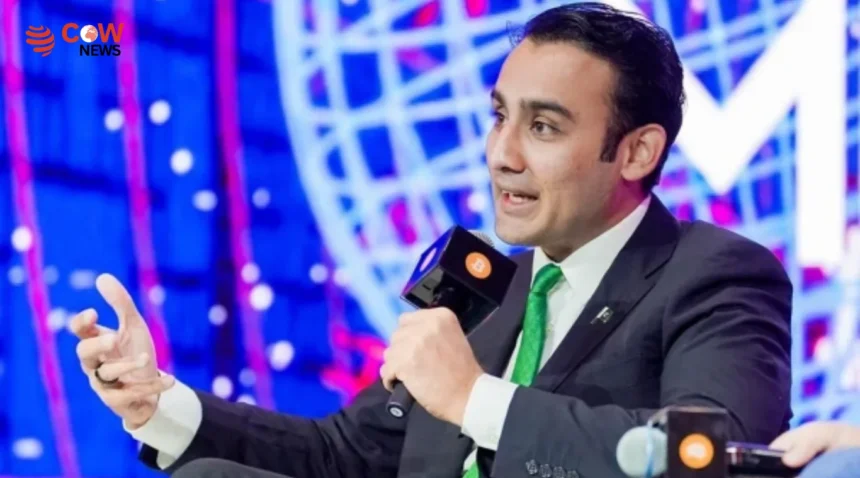
ISLAMABAD(The COW News Digital) State Minister and Pakistan Virtual Assets Regulatory Authority (PVARA) Chairman Bilal Bin Saqib has said that digital assets, blockchain and related technologies could provide significant opportunities for developing economies by improving financial inclusion, access and efficiency.
Addressing a virtual session held at the United Nations Headquarters on digital assets and blockchain for sustainable development, Bilal Bin Saqib called for stronger international cooperation to develop regulatory and institutional frameworks for the emerging digital financial system.
He urged the global community to move beyond discussions about digital assets and work collectively on practical regulations capable of shaping a more inclusive and responsible financial system.
According to the minister, digital assets, tokenisation and distributed ledger technologies could allow developing economies to redesign financial systems around greater accessibility and participation.
He said the key question was no longer whether these technologies would achieve widespread adoption, but who would shape them and whose interests they would ultimately serve.
Bilal Bin Saqib highlighted the large number of people who remain outside formal financial systems worldwide. He also pointed to high remittance costs, slow financial settlements and limited access to credit as continuing barriers to economic participation.
Referring to international remittances, he said the average cost of sending $200 remains more than twice the three-percent target set under Sustainable Development Goal 10.c. Reducing these costs, he argued, could enable billions of additional dollars to reach families directly each year.
The minister said the development potential of digital finance extends beyond payments. Digital identification systems and verifiable financial records could help small businesses, farmers and women entrepreneurs demonstrate economic activity without relying entirely on conventional documentation or collateral.
He added that tokenisation could create new ways of mobilising investment by dividing assets such as infrastructure bonds and renewable energy projects into smaller units. Distributed ledger technologies could also improve transparency in government spending and supply chains.
At the same time, Bilal Bin Saqib cautioned against treating technology as an automatic solution to every economic challenge. He identified market volatility, illicit financial activity, concentration of power and regulatory gaps between countries as key risks.
He called for regulation to develop alongside innovation, warning that delayed regulation may fail to protect consumers and markets, while policies based solely on fear could push digital activity into less transparent environments.
The minister said countries should view regulation as a means of building sustainable markets rather than simply restricting them.
The session was organised with the cooperation of Pakistan’s Permanent Mission to the United Nations, UNDP, UNCTAD and the Office of the Secretary-General’s Special Envoy for Technology. Representatives from member states, UN agencies and the private sector participated in discussions on digital assets, blockchain, artificial intelligence, digital identity and responsible implementation.
Bilal Bin Saqib stressed that no country develops in isolation and called for deeper international cooperation to ensure that emerging digital technologies contribute to inclusive and sustainable development.