
Lakki Marwat (The COW News Digital)Khyber Pakhtunkhwa Chief Minister Sohail Afridi has rejected the possibility of Governor’s Rule or an emergency in the province, declaring that the political vision and policies of Pakistan Tehreek-e-Insaf founder Imran Khan would continue to guide the provincial government.
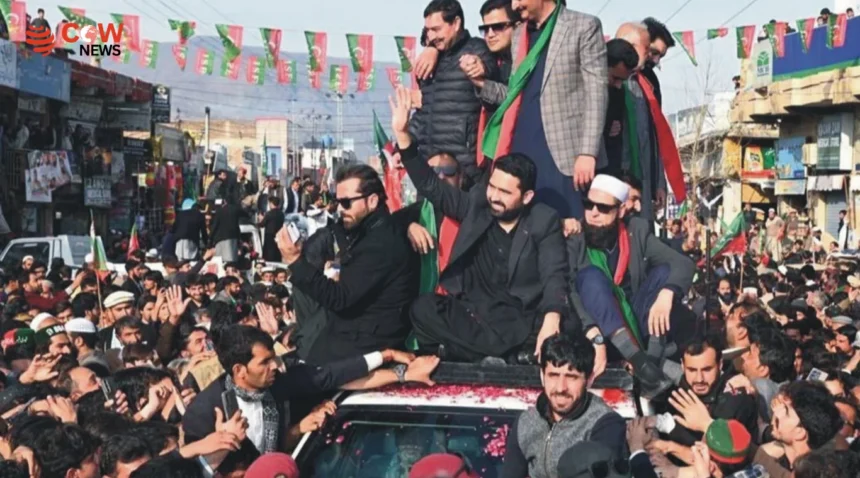
Addressing participants of the PTI long march at Gandi Chowk in Lakki Marwat, Afridi thanked the Pashtun people for their participation and praised what he described as their political determination. He said his government would not accept any policy that, in his view, could harm the people of Khyber Pakhtunkhwa.
Afridi described PTI as a political force and said the party’s negotiating committee had travelled to Islamabad with the objective of reducing political tensions and finding a political solution to ongoing disagreements.
The chief minister alleged that a mindset which makes decisions behind closed doors was attempting to impose another decision on the people. He said the people of Khyber Pakhtunkhwa had voted for Imran Khan’s political vision and insisted that the same vision and policy would continue in the province.
Afridi also rejected the possibility of Governor’s Rule and an emergency, saying his government would not accept either measure. His remarks came amid growing political debate over possible constitutional and administrative measures in Khyber Pakhtunkhwa following tensions between the federal government and the PTI-led provincial administration.
The chief minister further alleged that a political mindset that had dominated the country for decades was attempting to impose another round of military operations on the people of Khyber Pakhtunkhwa. He said the provincial government had presented the federal government with a clear policy for restoring peace.
According to Afridi, implementing the proposed policy could help establish peace in the province within 100 days. He argued that achieving peace required political will and claimed that the federal government’s priority was not peace but weakening the PTI.
Afridi said no political force could eliminate the PTI, adding that the party would continue its political struggle.
Discussing the security situation, the chief minister claimed that Khyber Pakhtunkhwa had experienced greater stability during Imran Khan’s tenure as prime minister. He attributed the subsequent increase in terrorism to what he described as a change in policy following the political transition commonly referred to by PTI supporters as the “regime change.”
“We will put out this fire,” Afridi said while referring to the security situation and the return of militancy in parts of the province.
He also urged young people and the general public to participate actively in the political process. According to the chief minister, the country’s future decisions should involve the younger generation.
Turning to the PTI long march, Afridi predicted a large turnout as the procession moved forward. He said a significant number of people would join the march in Karak and claimed that the scale of participation would become increasingly visible as the convoy moved towards Swabi.
The chief minister claimed that millions of people could eventually become part of the long march before the procession reaches Swabi. He described the movement as a campaign for what PTI calls “true freedom” and said it had spread across different parts of the country.
Afridi also urged party workers to remain politically committed and stand with Imran Khan and his wife, both of whom he referred to in the context of their imprisonment.
The chief minister’s remarks came as the PTI continued its mobilisation from southern Khyber Pakhtunkhwa toward Islamabad. His statements also reflected the widening political disagreement between the provincial and federal governments over security policy, governance and the future of the long march.
The federal government has separately raised concerns about security and law-and-order conditions in Khyber Pakhtunkhwa and has discussed constitutional and administrative options with provincial officials. The PTI-led provincial government, however, has rejected Governor’s Rule and an emergency and continues to insist that political dialogue remains the preferred route for resolving the dispute.
The political and security situation in Khyber Pakhtunkhwa remains fluid as the long march advances and both sides maintain sharply different positions on governance, counterterrorism policy and the province’s political future.