
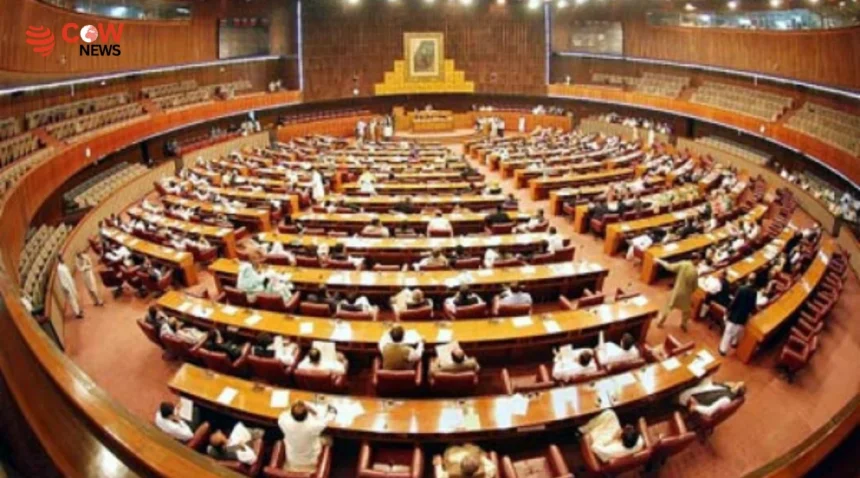
Islamabad (The COW News Digital) Pakistan’s parliament, in a joint sitting on Thursday, approved a resolution endorsing the imposition of emergency and Governor’s Rule in Khyber Pakhtunkhwa by a majority vote, amid strong protests from opposition lawmakers and heated exchanges over constitutional authority, security and provincial autonomy.
According to the proceedings, 214 members voted in favour of the resolution, while 56 opposed it. The session was chaired by National Assembly Speaker Sardar Ayaz Sadiq and attended by Senate Chairman Yousaf Raza Gilani, government ministers and opposition representatives.
Federal Minister for Parliamentary Affairs Dr Tariq Fazal Chaudhry presented the presidential declarations concerning the emergency under Article 232(7) and Governor’s Rule under Article 234(3) of the Constitution.
Opposition lawmakers attended the session wearing black armbands, challenged the counting process and continued chanting slogans during the proceedings.
Law Minister Azam Nazeer Tarar said the joint sitting had been convened to fulfil constitutional requirements, adding that the matter had already been discussed in the National Assembly and Senate.
He linked the government’s concerns to the deteriorating security situation in Khyber Pakhtunkhwa, referring to reported incidents in Lakki Marwat, Tank and Bajaur. Tarar argued that the provincial leadership should prioritise security challenges rather than political marches.
Interior Minister Mohsin Naqvi said the federal government had attempted to bring the provincial administration on board for joint counterterrorism efforts. He claimed that a plan had been developed for police operations in five districts, with federal support, but the provincial government had not taken the expected lead.
Federal Minister Amir Muqam also criticised the PTI-led administration, arguing that the province had experienced renewed insecurity despite previous counterterrorism agreements and initiatives.
Opposition leaders strongly condemned the decision, describing it as a threat to democracy, constitutional government and provincial rights.
Opposition Leader Mahmood Khan Achakzai said Pakistan’s political crisis stemmed from internal failures and a disregard for constitutional principles. He called for unconditional negotiations and demanded that parliament become the country’s principal source of political authority.
Achakzai also announced efforts to unite democratic parties against the move, arguing that provincial resources and constitutional rights must be respected.
PTI Chairman Barrister Gohar Ali Khan rejected allegations that his party supported terrorism. He said the party condemned terrorism in all its forms and urged the government to withdraw accusations against it.
Gohar described the emergency and Governor’s Rule as unacceptable measures, warning that the decision could damage relations between the federation and the province.
PTI Senator Ali Zafar questioned the constitutional basis of the action. Referring to Article 234, he asked the government to produce the governor’s report and explain how the president had reached the required level of satisfaction before imposing the measure. He also argued that maintaining law and order was a federal responsibility under the Constitution.
JUI Senator Kamran Murtaza raised similar objections, questioning whether the necessary constitutional conditions had been fulfilled and whether the president’s decision had been supported by the required documentation.
PPP Senator Sherry Rehman argued that terrorism and political confrontation should be treated as distinct issues. She defended the need for counterterrorism cooperation while criticising the political decisions that, in her view, had weakened negotiations.
ANP leader Aimal Wali Khan also challenged the government and opposition, arguing that responsibility for terrorism and political instability required broader accountability. He questioned whether the same standards should apply to federal and provincial governments.
Former prime minister Raja Pervaiz Ashraf urged political leaders to change their approach and resume dialogue. He said Governor’s Rule could potentially be reversed if political behaviour improved and negotiations became productive.
PPP lawmaker Shazia Marri described Governor’s Rule as a last resort and said the negotiating process had been weakened.
During the session, Prime Minister Shehbaz Sharif approached Mahmood Khan Achakzai’s seat and spoke with him privately for several minutes. Defence Minister Khawaja Asif also met the opposition leader after the prime minister left the chamber.
Separately, ANP leader Aimal Wali Khan met PPP Chairman Bilawal Bhutto Zardari, and the two exchanged views during the proceedings.
The joint sitting concluded with the government securing parliamentary endorsement for the emergency and Governor’s Rule. However, opposition objections over constitutional procedure, provincial autonomy and the government’s handling of security remain central to the political dispute.
The debate is likely to intensify calls for legal scrutiny and political negotiations as the country confronts continuing tensions over governance and security in Khyber Pakhtunkhwa.