
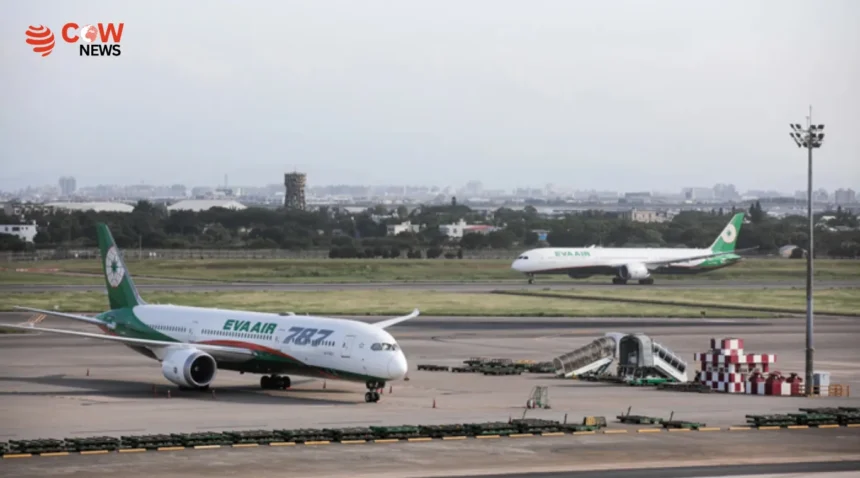
Islamabad (The COW News Digital) Pakistan has reportedly closed its airspace to Taiwanese airlines in support of China’s One China policy, a move that has forced major Taiwanese carriers to reroute flights between Asia and Europe, according to a report .
, Defence Minister Khawaja Asif said Pakistan’s aviation division was following the One China policy, under which only mainland Chinese airlines were permitted to fly over Pakistani territory.
Flight-tracking data from Flightradar24 indicates that China Airlines Ltd. and EVA Airways Corp., two major Taiwanese carriers, began changing their flight routes over the weekend. Both airlines reportedly stopped using Pakistani airspace entirely from the morning of October 25.
Since Sunday, at least a dozen flights operated by the carriers between Asia and Europe have travelled over Russian airspace, according to the report.
Bloomberg reported that both airlines declined to comment on the matter, while Taiwan’s Foreign Ministry had not issued an immediate response. Taiwan’s Civil Aviation Administration also declined to comment specifically on the rerouting but said it had never prohibited Taiwanese airlines from flying over Russia.
Although Russia has not formally banned Taiwanese airlines from its airspace, the carriers have generally avoided Russian routes since Moscow launched its invasion of Ukraine in 2022. Many airlines from Asia, Europe and North America have similarly restricted their use of Russian airspace because of the conflict and its associated operational risks.
The reported Pakistani restrictions appear stricter than mainland China’s own approach. According to Bloomberg, China allows Taiwanese airlines to use its airspace, despite Beijing’s position that Taiwan is part of China.
Pakistan’s decision could therefore have significant operational consequences for Taiwanese carriers, which have relied heavily on Pakistani airspace for certain long-haul services connecting Asia with Europe.
Flight data cited in the report showed that 14 flights operated by China Airlines and EVA Airways crossed Pakistani airspace on October 24 alone, highlighting the importance of the route to their operations.
With the airspace no longer available, airlines may need to take longer routes through other parts of South Asia, the Middle East or Russia, depending on individual flight plans and operational requirements.
The longer journeys could add several hours to some services and increase fuel consumption, crew costs and other operating expenses. Higher jet fuel consumption could place additional financial pressure on the airlines and potentially affect scheduling and operating efficiency.
The development also highlights the intersection of aviation policy and geopolitical relations in Asia. Airspace access can influence international flight planning, while government decisions based on diplomatic considerations may have wider consequences for commercial airlines and passengers.
However, the full financial impact of the reported restrictions remains unclear. Neither airline has publicly confirmed the extent of the additional costs or outlined how long the alternative routes may remain in use.