

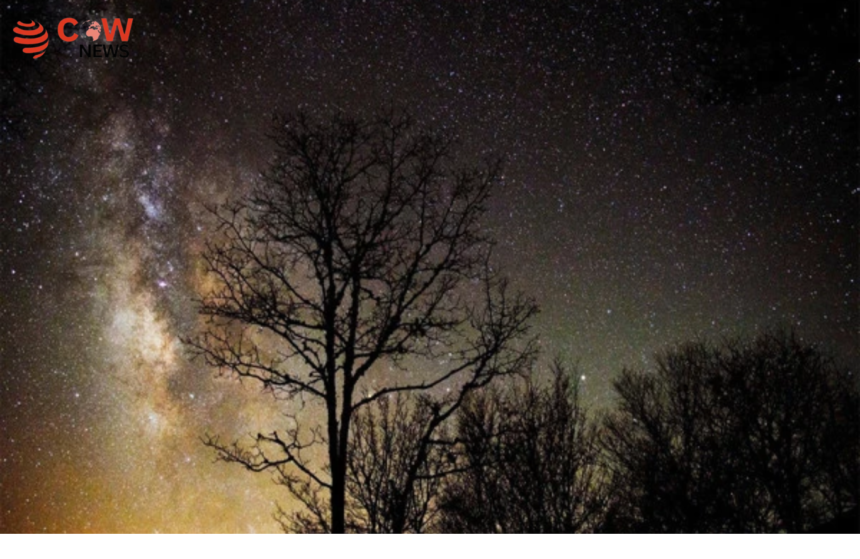
London (The COW News Digital) The growing number of artificial satellites orbiting Earth is changing the appearance of the night sky, with new analysis revealing that hundreds of spacecraft can pass over the United Kingdom at any given time.
The findings have raised concerns about the increasing presence of human-made objects in space and their potential impact on natural views of the universe.
An analysis conducted by British company Accu Components examined the movements of more than 15,000 active satellites orbiting Earth at altitudes below 2,000 kilometres.
The assessment monitored satellite activity over seven consecutive nights in October, highlighting the growing concentration of spacecraft in low Earth orbit.
According to the findings, more than 700 satellites may be passing across the UK sky at any given time.
The figure is particularly striking because it exceeds the number of stars that people can typically see with the naked eye in areas experiencing moderate levels of light pollution.
Although most satellites are not visible throughout the night, many can reflect sunlight and appear as moving points of light, particularly shortly after sunset and before sunrise.
The analysis suggests that the night sky above Britain has undergone a significant transformation over the past seven years.
According to the report, the changes during this relatively short period have been greater than those experienced over the preceding six decades.
The rapid expansion of satellite networks is considered a major factor behind this development.
Satellite constellations, which consist of large groups of interconnected spacecraft, are increasingly being deployed to provide global internet coverage, communications services, navigation support and Earth observation.
Companies operating these networks have expanded their activities to improve connectivity in remote areas and provide faster access to digital services.
However, the growing number of satellites has also raised questions about their environmental and scientific consequences.
One of the main concerns involves light pollution in space.
When satellites reflect sunlight towards Earth, they can appear as bright moving objects in astronomical observations.
This can interfere with ground-based telescopes and make it more difficult for astronomers to capture clear images of distant stars, galaxies and other celestial objects.
The issue is particularly important for professional observatories, which depend on dark and uninterrupted skies to conduct scientific research.
Satellite trails can affect astronomical images, potentially requiring researchers to identify and remove unwanted interference from their observations.
Astronomers have also expressed concerns about the impact of large satellite networks on scientific studies of the universe.
The increasing number of spacecraft could make it more challenging to observe faint astronomical objects, especially during periods when satellites are illuminated by sunlight.
Another concern is the growing risk of congestion in Earth’s orbit.
As more satellites are launched, operators face greater challenges in managing spacecraft movements and avoiding potential collisions.
Space debris, including damaged satellites and fragments from previous collisions, adds to the complexity of maintaining a safe orbital environment.
The latest analysis also warns that the situation could become more significant in the coming years.
Plans for additional large satellite constellations mean the number of spacecraft in orbit is expected to increase further.
Although satellite technology has become essential for modern communications, navigation, weather monitoring and scientific research, experts face the challenge of balancing technological progress with the protection of the natural night sky.
The growing presence of artificial satellites highlights how rapidly human activity is transforming the space surrounding Earth.
For astronomers and skywatchers, the concern is not simply the number of objects orbiting the planet but how their increasing visibility could change the experience of observing the universe.
As satellite networks continue to expand, questions about responsible space operations, orbital safety and the preservation of dark skies are likely to become increasingly important.
The findings underline the need for satellite operators, governments and scientific organisations to work together to reduce unnecessary interference and ensure that the benefits of space technology do not come at the expense of astronomical research.