
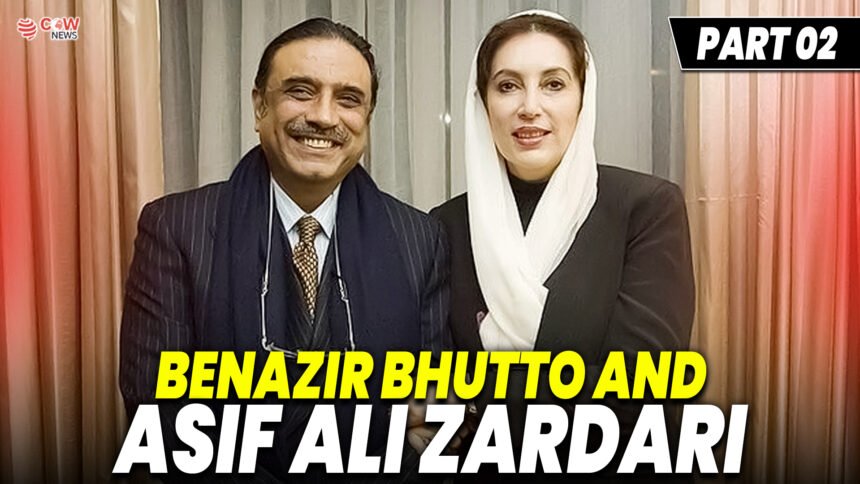
Asif Ali Zardari is the only son of Hakeem Ali Zardari, a prominent politician from Sindh. Growing up amidst luxury and influence, he inherited a legacy of wealth and business—over 2,001 acres of land and several major enterprises—but had no prior interest in politics. However, upon his marriage to Benazir Bhutto, he found himself thrust into an overwhelming storm of negative propaganda, for which he had no experience or preparedness.
A major challenge was that Zardari himself paid little attention to this propaganda and made no effort to counter it. His habit of remaining silent and not publicly rebutting allegations or false news caused lifelong damage to both his reputation and political stature.
Like many others, I received an invitation to attend Madam Benazir Bhutto’s public wedding ceremony in Karachi on December 17, 1987, but I could not attend.
A few months after her marriage, Madam Bhutto traveled to Peshawar to attend the wedding of Waqar Ahmed, son of a wealthy man from Dera Ismail Khan, Gulzar Ahmed. From Peshawar, she was to proceed to Dera Ismail Khan.
On that day, at Peshawar Airport, nearly all seats on the PIA Fokker flight to Dera Ismail Khan were occupied by Benazir Bhutto and senior PPP leaders. Among all the political passengers, I was the only journalist, seated next to a central PPP leader. Madam Bhutto and Asif Ali Zardari occupied seats a few rows ahead.
As the plane remained at the airport, the PPP leader beside me—who later became a federal minister—urged me to greet Madam Bhutto. With a tone of envy, he said, “Get up and meet her; she knows you. She doesn’t even recognize us.”
I stood, leaned forward, and said, “BB, Assalamualaikum.” Madam Bhutto turned, smiled warmly, and responded to my greeting. She introduced me to Asif Ali Zardari, who stood, shook hands with me warmly, and smiled broadly.
With his dusky complexion, thick black hair, and bright white teeth glinting beneath his prominent mustache, Zardari left a lasting impression on me. Seeing him with Benazir Bhutto reminded me of the story of Beauty and the Beast. To PPP activists and Bhutto supporters, Benazir was a princess, seemingly stolen by a “villain” named Zardari.
During our stay in Dera Ismail Khan, an incident occurred that angered both Aftab Ahmed Khan Sherpao and Madam Bhutto. During this time, the father and uncle of the current Khyber Pakhtunkhwa Governor, Faisal Karim Kundi, were key local power brokers and supporters of the military regime in Dera Ismail Khan under Zia. I noticed both Kundi brothers entering through a back door to meet Sherpao, who then introduced them to Madam Bhutto and Zardari. I reported in my newspaper that Aftab Sherpao had secretly facilitated this meeting between Zia’s associates and Madam Bhutto. For PPP leaders and activists in Dera Ismail Khan, this news was shocking and hurtful.
On August 17, 1988, near Basti Lal Kamal close to Multan, debris from the C-130 military aircraft crash fell, killing Pakistani generals and the U.S. ambassador, including unidentifiable remains of General Zia-ul-Haq. Interestingly, Zia had allegedly invited his Vice Army Chief General Aslam Beg onto his plane to Multan, but Beg declined politely, choosing another aircraft. Consequently, Generals Aslam Beg and Hamid Gul were not aboard Zia’s C-130, and Beg later saw the crash from his separate flight.
After returning to Rawalpindi, General Aslam Beg assumed the Army Chief position and appointed seasoned establishment figure Ghulam Ishaq Khan as President. In November 1988, Ghulam Ishaq Khan announced general elections.
Punjab’s Chief Minister and Zia’s protégé, Nawaz Sharif, inherited Zia’s political legacy and ran under the “Zia Shaheed” banner. Generals Aslam Beg and Hamid Gul, through the Islami Jamhoori Ittehad (IJI), attempted to block Benazir Bhutto and the PPP before the elections.
Before the elections, when Benazir visited Peshawar, I informed her that the provincial information department, led by the diminutive Ajmal Malik under Governor Fazl Haq, was spreading fake and indecent images of her and orchestrating malicious propaganda. Most senior journalists and newspapers in the province were under Malik’s influence, incentivized by personal benefits from Governor Fazl Haq and later CM Arbab Jehangir Khan. Ironically, Arbab Jehangir’s son and daughter-in-law later became prominent PPP leaders and ministers.
Despite all intimidation, rigging, and underhanded tactics by Aslam Beg and Hamid Gul, the PPP won 93 National Assembly seats in the November 16, 1988 elections. The IJI secured 56 seats, but Punjab was handed to Nawaz Sharif.
On December 2, 1988, the National Assembly elected Benazir Bhutto as Prime Minister, though Aslam Beg and Hamid Gul imposed conditions, including keeping Ghulam Ishaq Khan as President, appointing retired General Yaqub Ali Khan as Foreign Minister, and placing other key positions under military influence.
The day before her swearing-in, Daily Jang dismissed me from my job. The following day, I went to Islamabad with cartoonist Yusuf Lodhi to meet Benazir Bhutto. Owners of the Jang group, Mir Javed ur Rehman and likely Mir Shakeel ur Rehman, were also present. I informed my senior friend Wajid Shamsul Hassan that I wanted to complain about Jang’s owners to Benazir. He advised me not to make a scene and that he had already secured her forgiveness for Jang’s role during Zia’s era. I followed his advice, merely congratulated her, and left. Wajid, however, never fulfilled his promise.
From the very first day, the Prime Ministership was set on a bed of thorns for Benazir Bhutto. The real rulers were President Ghulam Ishaq Khan, Army Chief General Aslam Beg, ISI Chief General Hamid Gul, and members of her cabinet—all remnants of Zia’s regime. Zia’s ghost was everywhere.
Journalists loyal to Zia—Mujeeb-ur-Rehman Shami, Altaf Hassan Qureshi, Abdul Qadir Hasan, Asadullah Ghalib, “Khalifa” Haroon Rasheed, Maulvi Salahuddin, Saud Sahir, Zia Shahid, Khushnood Ali Khan, Saleh Zafar, Hanif Khalid, and Kamran Khan—attacked Benazir’s nascent government under ISI guidance. Asif Ali Zardari became an easy target for all these attackers.
During Indian Prime Minister Rajiv Gandhi’s visit, extreme chaos was created. Opposing journalists, allegedly on Hamid Gul’s instruction, spread false news claiming Benazir’s government had removed Islamabad-Kashmir highway boards and handed lists of Sikh Khalistan activists to Rajiv Gandhi. Every effort was made to undermine peace initiatives between Pakistan and India. Benazir Bhutto was portrayed as a security risk and threat to Pakistan.
To be continued