
Before continuing, a crucial correction regarding a fact mentioned in Part 6 is necessary, which was brought to my attention by our friend Dr. Zahid Rana, based in New York, USA. I am grateful to Dr. Rana for this clarification.
In the previous part, I had written that Nawaz Sharif had brought his relative Saif-ur-Rahman from Qatar to Pakistan and appointed him as head of the Accountability Bureau, responsible for severe punitive actions against Asif Ali Zardari. While this is true, Zardari’s major persecution by Saif-ur-Rahman actually occurred during Nawaz Sharif’s second and third terms as Prime Minister, between 1997 and 1999. Nevertheless, during Nawaz Sharif’s first term (1990–1993), Zardari remained imprisoned throughout.
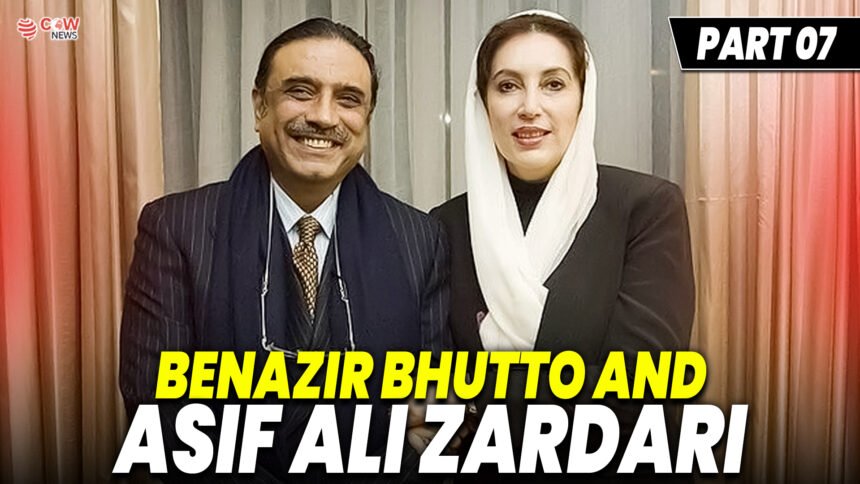
The military establishment had intended to weaken Benazir Bhutto by keeping Zardari in jail. Zardari was detained from October 10, 1990, until February 1993. During this period, Benazir Bhutto frequently faced harassment outside prisons while trying to meet her imprisoned husband.
In a remarkable turn of events, in April 1993, President Ghulam Ishaq Khan appointed the same Asif Zardari as caretaker federal minister—a man against whom the President had leveled multiple corruption charges in August 1990 to remove his wife from power. Zardari had been arrested in October 1990 under charges of kidnapping, attempted murder, and corruption, among sixteen other cases, and remained in continuous detention until February 1993. Over these three years of judicial proceedings, all charges against Zardari were proven false and baseless, leading to his release. Later, after the dismissal of Nawaz Sharif’s government in April 1993 by Ghulam Ishaq Khan, Zardari was appointed caretaker minister, with his oath administered by the very president who had previously imprisoned him. Only in Pakistan could such a paradox occur.
Returning to Nawaz Sharif’s first term, his connection with the generals who had brought him to power began to fracture. General Zia-ul-Haq had appointed General Khalid Mahmood Arif as Vice-Chief of Army Staff in 1984. In March 1987, when General KM Arif retired, Lieutenant General Aslam Beg was promoted to Vice-Chief of Army Staff. During Zia’s lifetime, Aslam Beg remained relatively unknown and worked behind the scenes, while Zia controlled national politics directly.
On August 17, 1988, the plane carrying General Zia-ul-Haq and several generals exploded shortly after takeoff from Multan en route to Rawalpindi, killing Zia and several other generals. Aslam Beg was with Zia in Multan that day but, despite Zia’s insistence, did not board the plane on the return journey. This mysterious action later led to accusations in 2012 by Zia’s son, Ejaz-ul-Haq, holding Aslam Beg responsible for his father’s death.
On the afternoon of August 17, 1988, Aslam Beg became Army Chief and, through Senate Chairman Ghulam Ishaq Khan, secured the presidency, paving the way for general elections in November 1988.
Aslam Beg often claimed that he could have imposed martial law on August 17, but he chose to restore democracy. The reality, however, was that Beg understood that after Zia’s eleven-year rule, public trust in the military had eroded and the populace was not prepared for another martial law. Consequently, Beg and his colleagues planned a hybrid system of governance: a civilian government would appear in front, while real power remained with the military.
For this system to work, Pakistan’s largest opposition party, the Pakistan Peoples Party (PPP), had to participate in the elections but be constrained from gaining sufficient power. This would satisfy the public’s anger against the military while ensuring PPP could not exercise genuine authority.
Beg’s hybrid system faced limitations. Despite all attempts at manipulation by Beg and Hamid Gul, the PPP won the highest number of National Assembly seats—94 in total. However, electoral fraud ensured that the party could not form a strong federal government alone. The Urdu-speaking Aslam Beg instructed the PPP to ally with MQM to establish the government.
Before forming the new government, Beg and his fellow generals blackmailed the PPP, granting permission to form the cabinet only after Benazir Bhutto agreed to give key ministries to the generals’ loyalists and accept Ghulam Ishaq Khan, armed with the threat of Article 58(2)(b), as President for a five-year term. This marked the beginning of the hybrid system, whose underlying philosophy was that civilians, particularly liberal and Western-oriented figures like Bhutto, could not be trusted with real authority.
The generals could not tolerate Bhutto even for a few months. They first attempted to remove her through a vote of no confidence, which failed, with Asif Zardari playing a pivotal role in thwarting it. Twenty months later, at the behest of the generals, Ghulam Ishaq Khan dismissed the PPP government. In earlier installments, I detailed how General Aslam Beg, General Hamid Gul, and ISI Chief General Asad Durrani facilitated the 1990 elections to ensure IJI’s victory and Nawaz Sharif’s rise to power.
As the founder of the hybrid system, Aslam Beg had expected his “puppet,” Nawaz Sharif, to obey military directives blindly. However, Sharif emerged as an independent civilian leader. On the Iraq crisis, when Sharif gave Beg a direct “shut-up” order, Beg began issuing statements contrary to government policy.
After February 1991, when Iraqi forces withdrew from Kuwait and the war ended, a new struggle for power began in Pakistan. This time, Aslam Beg stood alone; General Hamid Gul did not support him. Gul assumed that Sharif would appoint him the next Army Chief. Beg sought assistance from Ghulam Ishaq Khan, who had been made President after Zia’s death, but the President turned away from him. On August 16, 1991, Beg retired, leaving Sharif to select the new Army Chief.
Hamid Gul, one of four generals considered for the Army Chief post, believed Sharif shared his jihadi mindset and expected to be rewarded due to his role in forming the IJI and ensuring its electoral success. However, Sharif advised President Ishaq Khan to appoint Lieutenant General Asif Nawaz Janjua instead, leaving Gul deeply humiliated.
After assuming command, General Janjua assigned Hamid Gul to oversee Wah Ordinance Factory and defense production, which Gul perceived as an insult, prompting his resignation.
By refusing to extend the tenure of a powerful Army Chief like Aslam Beg and sidelining a high-profile, self-willed jihadi general like Hamid Gul, Prime Minister Nawaz Sharif demonstrated that he was not a puppet but a genuine civilian leader. He also chose to distance himself from General Zia’s jihadi legacy, sending shockwaves through the jihadi camp.
Retired General Hamid Gul, no longer in active service, began seeking a new Islamic hero. Initially, he considered JI’s Qazi Hussain Ahmad but soon focused on Imran Khan, a former protégé of Zia, as a potential new savior of the jihadi vision.
(To be continued.