
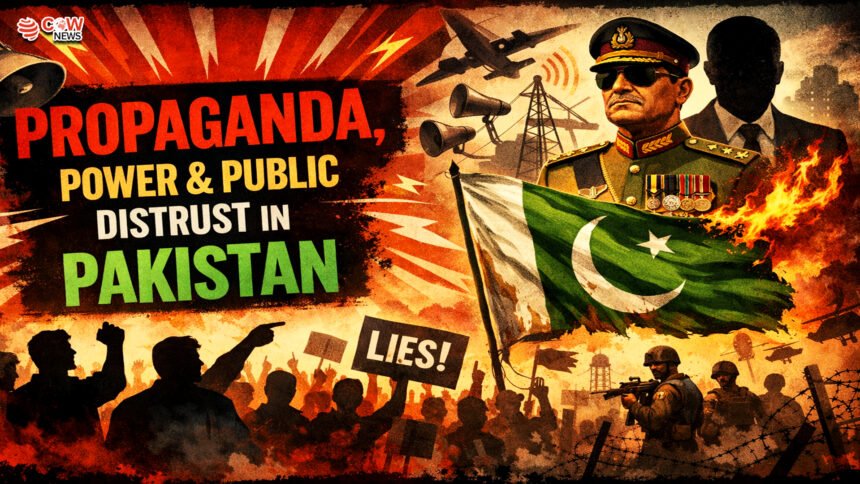
Pakistan today is not merely facing a political crisis. It is confronting a crisis of truth. The country’s public sphere has become a battlefield where competing narratives, amplified by television studios, YouTube channels, and social media platforms, are waging an unrelenting war. Facts are blurred, reputations are shredded, and institutions are weaponized in an environment where outrage often matters more than evidence.
The deterioration of public discourse did not happen overnight. It is the result of decades of political engineering, ideological manipulation, and media commercialization. What once passed for political debate has increasingly turned into character assassination. The loudest voices dominate the conversation, while nuance and verification struggle to survive.
In Pakistan, narratives are not accidental. They are crafted, promoted, and strategically deployed. Political actors across the spectrum — whether aligned with the establishment or in opposition — have relied heavily on media surrogates to shape public opinion. Over time, this has created a culture where loyalty is rewarded more than credibility.
The phenomenon is particularly visible in the rise of hyper-partisan commentators. Many media personalities openly align themselves with political camps. Their role is less about informing the public and more about defending or attacking specific figures. As a result, journalism increasingly resembles political campaigning.
This environment rewards aggression. The more confrontational the tone, the greater the visibility. Social media algorithms amplify outrage, and television ratings thrive on confrontation. Civility becomes a liability; sensationalism becomes currency.
Pakistan’s political history has been marked by ideological slogans — from “Islamic system” to “accountability” to “change.” Yet beneath these slogans often lies opportunism. Political actors frequently reinvent themselves, shifting alliances according to the winds of power.
The public, however, rarely forgets. When former critics become allies and former allies turn into adversaries, citizens are left questioning sincerity. This pattern has deepened cynicism. Voters increasingly believe that principles are negotiable and that power is the ultimate objective.
The cost of this opportunism is institutional erosion. When politics becomes a revolving door of shifting loyalties, trust in democratic structures weakens. Parliament, political parties, and even the judiciary risk being perceived not as guardians of constitutional order but as instruments within larger power struggles.
No discussion of Pakistan’s political discourse can ignore the country’s complex civil–military dynamic. For decades, the military establishment has played a decisive role in shaping national direction. At various times, segments of the media have echoed or amplified establishment-friendly narratives.
But the dynamic has not remained static. In recent years, political leaders who once benefited from establishment support have turned into its critics. Media figures who previously defended state institutions have repositioned themselves. The result is a fragmented information landscape in which yesterday’s allies become today’s accusers.
This fluidity has produced a strange phenomenon: everyone claims victimhood. Political parties accuse the establishment of manipulation. The establishment accuses politicians of destabilization. Journalists accuse both sides of pressure and censorship. Meanwhile, the public struggles to determine where truth ends and propaganda begins.
The digital revolution has further transformed Pakistan’s political communication. YouTube channels, Facebook live sessions, and X (formerly Twitter) threads now compete with mainstream news outlets. Independent content creators have amassed millions of followers, bypassing traditional editorial filters.
This democratization of media has positive aspects. It allows alternative voices to be heard and challenges monopolies of information. Yet it also creates fertile ground for misinformation. Rumors spread faster than corrections. Emotional appeals outperform fact-checks.
Digital populism thrives on binary thinking: hero versus villain, patriot versus traitor, believer versus conspirator. Complex policy debates are reduced to viral soundbites. In this ecosystem, measured analysis struggles to compete with dramatic accusations.
One of the most damaging trends in Pakistan’s media landscape is the normalization of character attacks. Political disagreement often crosses into personal vilification. Accusations are made publicly before evidence is established. Reputations are tarnished in minutes; legal recourse, if any, takes years.
This culture discourages capable individuals from entering public life. Why risk professional credibility or personal safety in a system where narratives can be manipulated overnight? The long-term effect is a shrinking pool of competent leadership and a widening gap between citizens and institutions.
It also undermines democratic maturity. Democracies require vigorous debate, but they also require responsibility. When discourse degenerates into insult and insinuation, society loses the ability to engage constructively.
Pakistan’s journalism community faces a defining moment. The profession has produced courageous reporters who have exposed corruption, challenged authoritarianism, and paid heavy personal costs. Yet it has also seen segments drift toward partisan activism.
Economic pressures play a role. Media houses struggle with declining revenues. Advertising dependency creates vulnerabilities. Political patronage becomes tempting. In such circumstances, editorial independence can erode.
The result is a credibility crisis. Surveys consistently show declining public trust in media. When audiences believe that news outlets serve political masters, the very foundation of journalism — public confidence — weakens.
Another troubling development is the politics of moral absolutism. Political movements often portray themselves as uniquely righteous, framing opponents not merely as rivals but as existential threats. This rhetoric fuels polarization.
History shows that no political force in Pakistan has a monopoly on virtue. Corruption allegations, governance failures, and power struggles have affected multiple administrations across decades. Selective outrage only deepens divisions.
True reform requires institutional strengthening rather than personality-driven crusades. Transparency, accountability mechanisms, and rule of law must apply universally — not selectively.
The broader casualty of this narrative war is social cohesion. Families argue over politics. Friendships fracture along partisan lines. Social media timelines become echo chambers reinforcing existing biases.
Meanwhile, pressing issues demand attention: economic instability, education reform, healthcare access, climate vulnerability, and youth unemployment. When national conversation revolves primarily around personality conflicts, structural challenges remain unaddressed.
Pakistan’s young population — a demographic asset — deserves a political culture that prioritizes solutions over slogans. Endless narrative battles drain energy that could otherwise drive development.
Rebuilding trust requires collective effort. Political leaders must lower the temperature of rhetoric. Media organizations must recommit to verification and editorial standards. Audiences must cultivate critical thinking, resisting the temptation to accept information that merely confirms prior beliefs.
Educational institutions also play a role. Media literacy programs can equip citizens to distinguish fact from manipulation. Civil society organizations can promote dialogue across ideological divides.
Most importantly, accountability must be consistent. Selective justice fuels resentment. Transparent processes strengthen legitimacy.
Pakistan stands at a crossroads. The country can continue down the path of narrative warfare, where propaganda eclipses policy and outrage substitutes for reform. Or it can choose a more disciplined, responsible political culture.
History suggests that societies eventually tire of perpetual conflict. Sustainable stability requires more than slogans. It requires institutions that function independently, media that report responsibly, and citizens willing to demand integrity.
The crisis of truth is not insurmountable. But confronting it demands courage — not just from politicians and journalists, but from the public itself.
Until then, Pakistan’s war of narratives will continue, echoing across television studios and digital platforms, shaping perceptions and redefining alliances. The question is not whether narratives will exist — they always do. The question is whether they will enlighten or mislead, unite or divide.
By Shiraz Paracha