
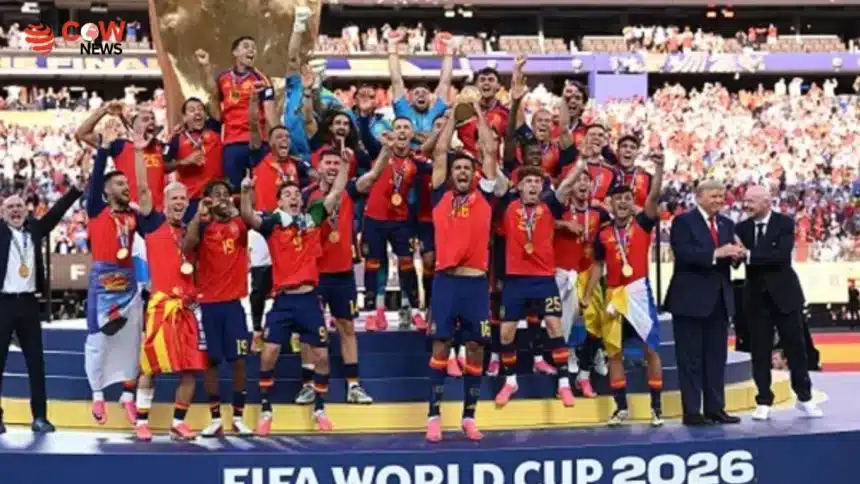
New York: Spain defeated defending champions Argentina 1-0 after extra time to lift the FIFA World Cup 2026 trophy, securing their second men’s world title in a tense and hard-fought final on Sunday. Ferran Torres scored the decisive goal in the 106th minute, ending Argentina’s hopes of retaining the championship and marking a historic night for Spanish football.
The final, played before a packed stadium, was expected to showcase attacking football but instead developed into a physical contest filled with fouls, interruptions, and tactical battles. Despite the stop-start nature of the match, Spain created the better scoring opportunities throughout the game.
Argentina goalkeeper Emiliano Martínez produced a series of outstanding saves to keep his side in contention during both regular and extra time. His performance denied Spain on multiple occasions and kept the defending champions alive until the closing stages.
Argentina’s challenge became significantly more difficult late in normal time when midfielder Enzo Fernández was sent off after receiving a second yellow card for a dangerous tackle. Reduced to ten men, the South American side struggled to contain Spain’s relentless pressure in extra time.
The breakthrough finally arrived in the 106th minute. Nico Williams won an aerial challenge before the ball fell to Ferran Torres, who struck a powerful close-range finish into the net to give Spain the only goal of the match. Spain’s attack, led by Lamine Yamal, Mikel Oyarzabal, and Williams, consistently tested Argentina’s defense throughout the contest. Williams also had a goal ruled out for a foul earlier in the game.
The final attracted worldwide attention beyond the action on the pitch. U.S. President Donald Trump attended the match as a special guest, while FIFA organized its first-ever World Cup halftime entertainment show, featuring performances by international music stars including Shakira, Madonna, and Justin Bieber.
Spain’s victory marked its second FIFA Men’s World Cup title after winning the tournament for the first time in 2010. The triumph also earned the country a unique place in football history, making Spain the first nation to simultaneously hold both the FIFA Men’s and Women’s World Cup titles.
For Argentina, the defeat ended its bid to win back-to-back World Cups after lifting the trophy in 2022. The final was also widely viewed as Lionel Messi’s possible last appearance at a FIFA World Cup, adding emotional significance to the occasion. While the legendary captain was unable to guide Argentina to another historic triumph, Spain celebrated a memorable victory that crowned them the new champions of world football.