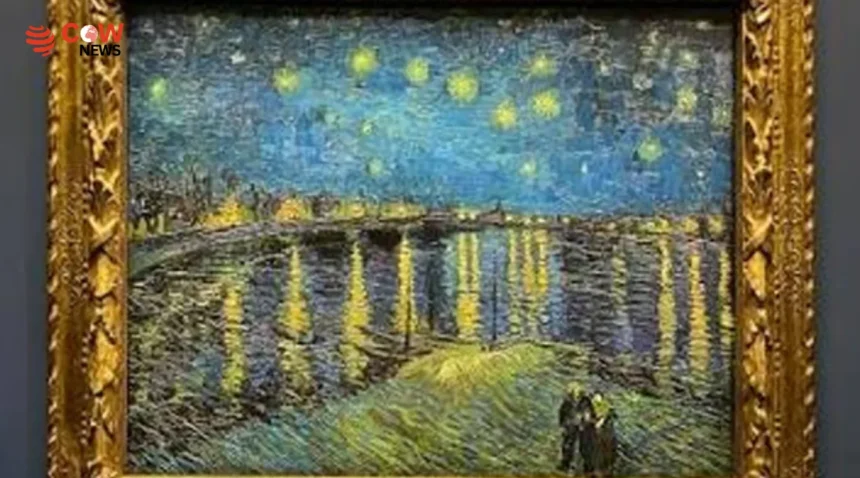
Paris (The COW News Digital) Scientists have made a fascinating discovery about Vincent van Gogh’s world-famous painting The Starry Night, suggesting that the artwork may depict a real astronomical scene observed before sunrise over southern France in July 1889.
According to researchers, the painting may represent the sky above Saint-Rémy-de-Provence around July 22, 1889, offering a new perspective on one of the most celebrated masterpieces in modern art. The findings highlight how scientific observations and astronomical calculations can help researchers investigate the real-world inspiration behind iconic paintings.
Created in 1889, The Starry Night is renowned for its swirling sky, luminous stars and striking contrast between the night sky and the landscape below. Although the painting has long attracted attention for its artistic beauty and symbolic meaning, researchers have also attempted to determine whether its celestial features correspond to actual astronomical observations.
Astronomers have spent decades examining the painting and studying the positions of stars that might have inspired van Gogh. Two significant studies published in the mid-1980s offered different interpretations of the celestial objects represented in the artwork. The conflicting findings contributed to continuing debate over the astronomical scene depicted by the Dutch painter.
The latest investigation was inspired by questions about earlier interpretations of the painting. According to the study’s lead author, the existing explanations did not fully satisfy his curiosity about the sky represented in the artwork, prompting a fresh examination of its celestial details.
Elijah Jeonghyeon Kim, a doctoral student at Kyung Hee University in South Korea, approached the painting from the perspective of an observational astronomer. He suggested that the cluster of stars depicted in The Starry Night corresponds to the Hyades, an open star cluster located in the constellation Taurus.
Kim said that reading previous research identifying the cluster as part of Aries prompted him to investigate the painting more closely. His astronomical perspective led the research team to reconsider the positions and arrangements of the stars visible in the artwork.
To investigate the theory, researchers examined the location associated with the painting’s creation and analysed the shapes and positions of prominent celestial features. They then compared these details with astronomical information to determine whether the five central stars identified in their analysis matched the sky visible on the proposed date.
According to the researchers, a sketch that van Gogh produced after completing the famous painting appears to correspond even more closely with the astronomical scene under investigation. This additional evidence may help researchers better understand how the artist observed and interpreted the sky.
However, the findings should be understood as a scientific interpretation rather than definitive proof of every detail represented in the painting. Artistic works can combine direct observation, imagination and creative rearrangement, making it difficult to establish an exact correspondence between a painted scene and a particular moment in the natural world.
The research nevertheless demonstrates how astronomy can provide fresh insights into historical artworks. By combining knowledge of celestial objects with historical locations and dates, scientists can explore the relationship between artistic imagination and the observable universe.
More than a century after its creation, The Starry Night continues to inspire artists, historians and scientists alike. The latest investigation adds another dimension to the enduring fascination with van Gogh’s masterpiece, suggesting that its extraordinary sky may preserve clues to a real astronomical scene witnessed in southern France in 1889.