


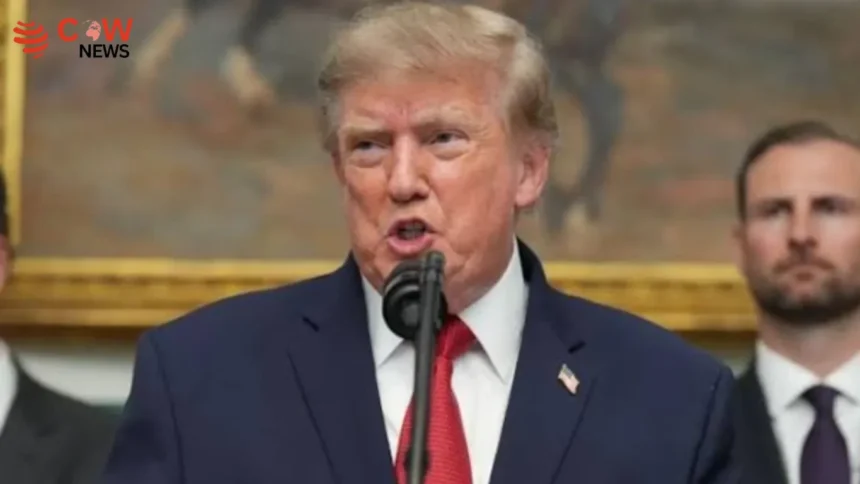
Washington (The COW News Digital) US President Donald Trump has claimed that Saudi Arabia and several other Gulf countries have asked his administration to refrain from launching further major attacks on Iran and maintain the current strategy of military and economic pressure.
Trump said Saudi Arabia had requested that the existing situation be allowed to continue for some time. He added that Qatar, Kuwait, the United Arab Emirates and Bahrain also supported maintaining the current US approach.
According to Trump, these countries had urged him not to escalate military operations against Iran. He said he did not entirely agree with the strategy but was taking the requests of regional allies into consideration.
When asked whether he would have ordered additional attacks if Gulf countries had not requested restraint, Trump indicated that he would have done so.
The US president also claimed that American forces could severely damage Iran’s energy infrastructure, bridges and industrial production capacity within a short period.
Trump said that if he decided to take such action, Iran’s energy system, bridges and industrial facilities could be targeted. He claimed the process could begin within a day and that the broader destruction could be completed within three days.
However, he said the United States was currently maintaining economic and military pressure rather than immediately launching another major wave of attacks.
Trump maintained that he could bring the conflict to an end quickly but suggested that Washington was continuing its present approach for strategic reasons.
His remarks indicate that the administration is weighing military options alongside the concerns of regional partners, particularly countries that could face wider consequences if tensions escalate further.
The Gulf region has significant strategic importance because of its energy infrastructure, international shipping routes and proximity to Iran. Any expansion of military operations could have implications for regional security and global energy markets.
Trump’s comments also highlighted the role of Gulf governments in discussions surrounding the next phase of the conflict. However, the claims about their requests and support were presented by the US president during the interview and were not independently confirmed in the supplied report.
During the interview, Trump acknowledged that rising petrol prices linked to the Iran conflict had affected the Republican Party’s performance in the midterm elections.
Higher fuel costs can create financial pressure on households and businesses, making energy prices an important domestic political issue in the United States.
Despite acknowledging the economic impact, Trump defended his decision to pursue military action against Iran and indicated that his position on the conflict had not changed.
The comments come amid continuing diplomatic efforts to address the conflict, reduce regional tensions and discuss possible ways to bring the fighting to an end.
For Gulf countries, the situation presents significant security and economic concerns. Their governments have an interest in preventing further escalation while maintaining regional stability and protecting vital infrastructure.
Trump’s latest statements suggest that Washington is continuing to consider the concerns of its Gulf partners while keeping military and economic pressure on Tehran.
Whether the current strategy will lead to diplomatic progress or further confrontation remains uncertain. Much will depend on developments involving the United States, Iran and regional governments in the coming days.