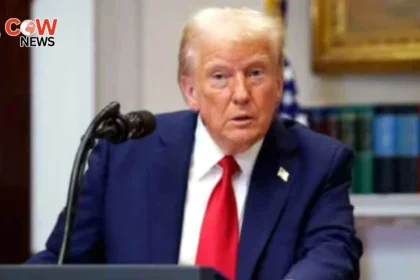
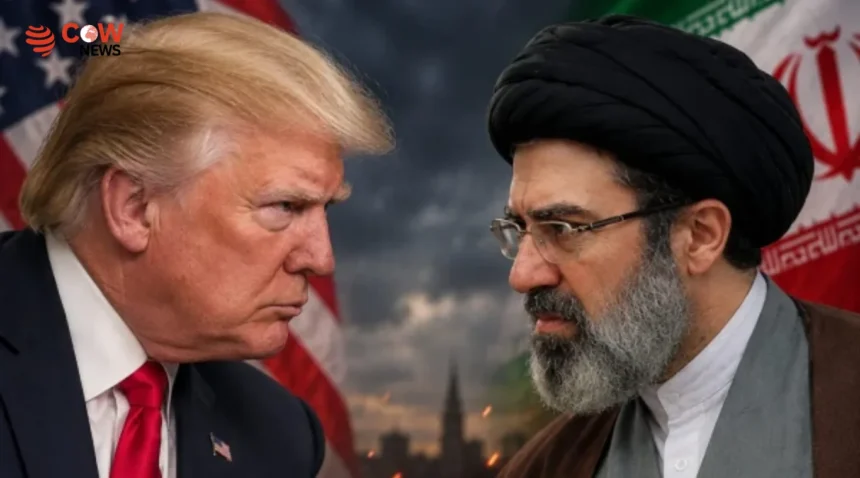
Washington(The COW News Digital) US President Donald Trump has again warned Iran that Washington could pursue military action if the two sides fail to reach an agreement, as diplomatic contacts between the United States and Iran continue amid the ongoing regional conflict.
Speaking to reporters, Trump indicated that the United States was facing a choice between reaching a deal with Tehran and taking further military action. His latest remarks came as intermediaries continue efforts to maintain communication between the two countries.
The warning adds to uncertainty surrounding the future of US-Iran relations, with negotiations focused on ending hostilities, easing pressure on Iran and restoring normal maritime traffic through the Strait of Hormuz.
Iran has proposed a seven-day plan under which the Strait of Hormuz could be reopened and broader negotiations resumed if Washington accepts Tehran’s conditions. Iranian Foreign Minister Abbas Araqchi presented the proposal through diplomatic channels and said implementation would depend on the United States agreeing to the terms.
The strategic waterway has remained at the center of the confrontation because of its importance to global energy shipments. Disruptions in the region have contributed to volatility in international oil and fuel markets, while Gulf countries have also been closely monitoring developments.
Despite Trump’s public rejection of Iran’s proposal in recent days, diplomatic channels have remained active through mediators. Reuters reported that Iranian Foreign Minister Abbas Araqchi said Tehran was still waiting for the United States’ definitive position through intermediaries, while Trump had separately indicated that further talks could take place.
The latest developments have produced mixed signals, with Washington maintaining pressure on Tehran while diplomatic efforts continue behind the scenes. Iran has continued to push for a diplomatic solution and has linked the reopening of the Strait of Hormuz to conditions involving sanctions, military pressure and the broader ceasefire framework.
US Defense Secretary Pete Hegseth has also made strong claims about the impact of American military operations against Iran. According to reports, Hegseth said US forces had significantly damaged Iranian military capabilities, including naval and air assets, defensive systems and elements of its military infrastructure. Those claims have not been independently verified in their entirety.
Meanwhile, markets remain sensitive to developments surrounding the conflict and the possibility of changes in shipping through the Gulf. Reuters reported on October 1 that Gulf markets were responding to mixed diplomatic signals between Washington and Tehran, while oil prices also remained volatile.
Iranian officials have continued to emphasize diplomacy, while the Trump administration has maintained that any agreement would need to address Washington’s broader concerns.
For now, diplomatic contacts have not produced a publicly announced comprehensive settlement. The situation remains fluid, with military pressure, sanctions, the Strait of Hormuz and the future of negotiations all forming key elements of the dispute.
Any further statement from Trump or a formal response from Tehran could influence the direction of the talks as both sides weigh their next steps.