

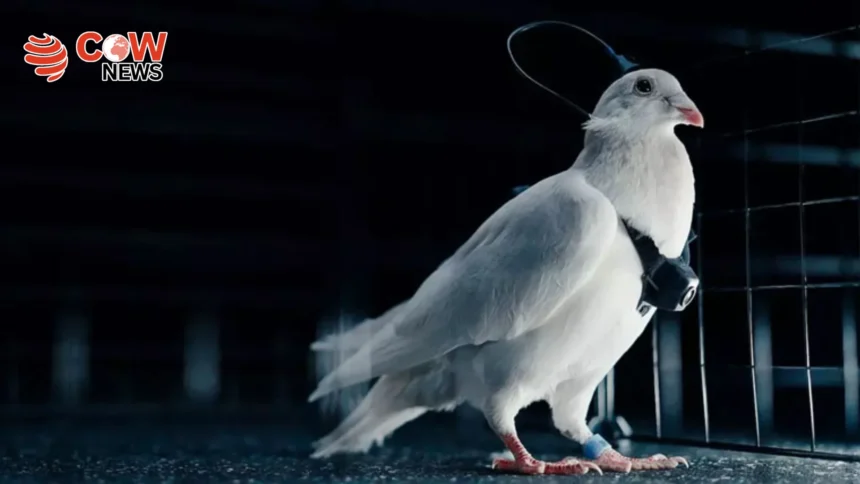
Moscow(The COW News Digital) A Russian company has claimed a technological breakthrough, converting pigeons into surveillance drones, also referred to as “bio-drones.” The development, announced by neurotechnology firm Neiry Group, involves installing brain implants on pigeons that allow their flight paths to be remotely controlled.
According to the company, these implants can send electrical signals directly to the birds’ brains, instructing them to turn left or right or follow a specific route—without the need for pilot training. This enables the pigeons to operate like traditional drones, providing live video feeds for surveillance purposes.
Each pigeon is equipped with miniature cameras, GPS devices, and solar-powered controls, making them capable of extended flight durations and operation in restricted or challenging airspaces where conventional drones might struggle.
The company claims that bio-drones offer several advantages over standard unmanned aerial vehicles. Their natural flight abilities allow them to navigate complex environments and remain operational for longer periods. In addition, the discreet appearance of pigeons makes them less likely to be detected during monitoring missions.
Read More:
- Trump Hopes Iran Talks Succeed, Warns Against Midnight Hammer
- Maria B Makes History with Grand Debut in Bangladesh
- CENTCOM Warns Iran’s Revolutionary Guards Against Unsafe Acts
Experts, however, remain cautious about the practical applications of such technology. Concerns have been raised regarding animal welfare, regulatory approval, and the ethical implications of controlling living creatures for surveillance. Independent verification of Neiry Group’s claims is still pending, and it is unclear when or if these bio-drones will be deployed commercially or for government use.
If successful, the technology could represent a new frontier in hybrid bio-robotics, combining natural animal behavior with advanced neuro-control systems. Such innovation may pave the way for further research into integrating biological systems with AI-driven monitoring and control.
The announcement has generated global attention, highlighting Russia’s investment in experimental neurotechnology and drone development. While bio-drones may still face significant technical and ethical hurdles, they illustrate the growing interest in unconventional methods for surveillance and data collection.