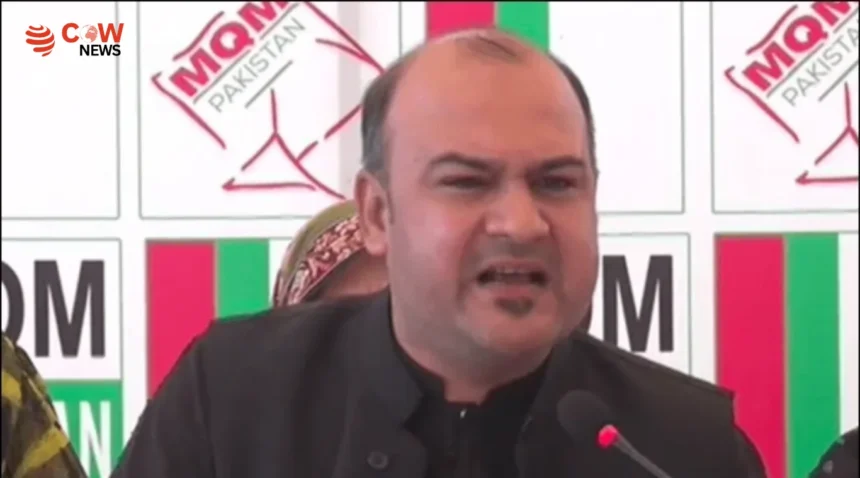
KARACHI(The COW News Digital) Opposition Leader in the Sindh Assembly Ali Khursheedi has called for a change in the country’s governance model, arguing that the 18th Constitutional Amendment has failed to deliver the level of governance and public empowerment that was expected from it.
Speaking to the media during a programme organised by the All Pakistan Muttahida Students Organisation (APMSO) at the University of Karachi, Khursheedi said Pakistan needed to move towards the creation of new administrative units to improve governance and address growing challenges faced by citizens.
Khursheedi said the issue of creating new provinces should not be viewed merely as a dispute between political parties. According to him, resistance to the creation of new provinces was linked to the interests of two political families, while ordinary citizens were demanding a more effective system of administration.
He said the existing governance structure was failing to adequately empower citizens, particularly young people. “What are we doing for the youth?” he asked, stressing that political and administrative systems should focus more directly on public needs.
Referring to conditions in Karachi, the opposition leader said the city was facing serious problems in education, infrastructure and public services. He argued that changing the governance model could bring improvements across different sectors.
Khursheedi also criticised the state of educational institutions in Karachi, referring to reported irregularities in matriculation and intermediate examination results. He questioned why action had not been taken despite reports highlighting problems in the examination system.
The MQM-P leader also raised concerns over the prolonged condition of University Road, saying millions of students had been affected by difficulties caused by ongoing infrastructure issues. He criticised the Sindh government for repeatedly announcing that work on the road would be completed while the problems continued.
He said the Orange Line project had also remained a longstanding concern and claimed that public announcements about development projects had not been matched by timely completion.
On education funding, Khursheedi referred to the allocation of Rs22 billion under the school-specific budget and said the funds should actually be spent on improving schools and educational facilities.
Commenting on governance in Sindh and Punjab, he described Sindh’s system as ineffective and characterised Punjab’s administration as overly centralised around one political figure.
Khursheedi further said that the country’s administrative structure was operating through temporary arrangements rather than long-term institutional solutions. He argued that a comprehensive governance reform was necessary to address these issues.
During the media interaction, he was also asked about rising petrol prices. Khursheedi acknowledged that fuel prices remained a problem but said the issue could not be resolved through his personal statements. He expressed hope that improvements in international circumstances would eventually provide relief.
His remarks come amid an ongoing political debate over administrative reforms, provincial governance and the possibility of creating additional administrative units in Pakistan. The proposal remains a politically contested issue, with different parties holding differing positions on provincial restructuring and the implementation of the 18th Amendment.