
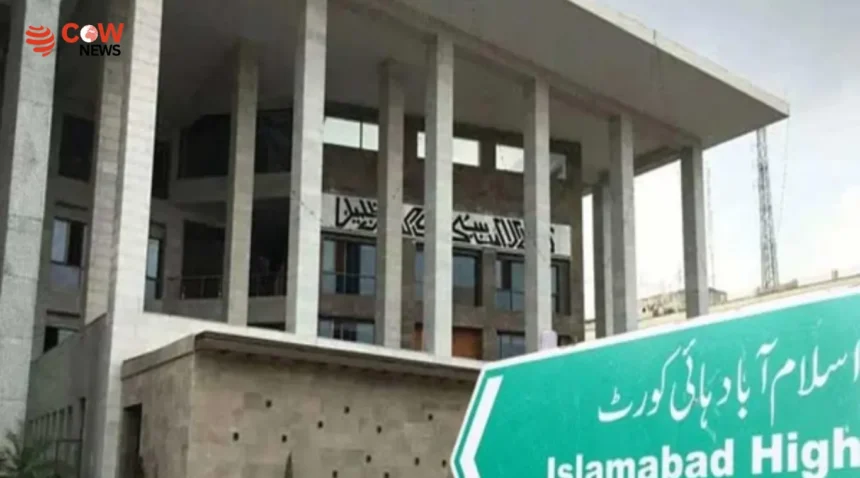
Islamabad (The COW News Digital) The Islamabad High Court has ruled that courts cannot issue pre-emptive judgments to prevent the enactment of potential laws in the future, disposing of a constitutional petition challenging a 2024 ordinance that extended the National Accountability Bureau’s physical remand period from 14 days to 40 days.
In its written judgment, Justice Inam Ameen Minhas observed that the NAB Amendment Ordinance had automatically lapsed after its legal validity expired. Consequently, the court found that no live dispute remained before it regarding the ordinance.
The judge stated that once the ordinance had ceased to remain in force, there was no need for the court to examine or express an opinion on its constitutional status.
The written order also noted that the petitioner had failed to establish that any proceedings or punishment had been imposed against them under the challenged ordinance.
The court further explained that judicial intervention could not be sought in advance to stop laws that might be introduced in the future. On these grounds, the Islamabad High Court disposed of the constitutional petition against the NAB Amendment Ordinance 2024 after declaring it ineffective.
The ordinance had increased the maximum period of physical remand in NAB custody from 14 days to 40 days. It was promulgated by the acting president on May 27, 2024.
However, the ordinance did not receive an extension from Parliament and was not converted into a regular act of Parliament. As a result, its legal validity expired, removing the immediate basis for the petition challenging its constitutional standing.
The court’s decision focused on the ordinance’s expiry and the absence of an ongoing dispute requiring judicial determination. It did not deliver a substantive ruling on the constitutionality of the provisions that had extended the physical remand period.
The ruling reflects the distinction between reviewing an existing legal measure and being asked to prevent possible legislation before it is enacted. According to the court, judges cannot issue advance decisions against laws that may be introduced in the future.
The Islamabad High Court’s decision follows a similar development at the Lahore High Court, which had also disposed of a petition of the same nature after the relevant NAB ordinance expired.
The case concerned the legal consequences of the ordinance’s expiry and whether a constitutional challenge remained necessary once the measure was no longer in force.