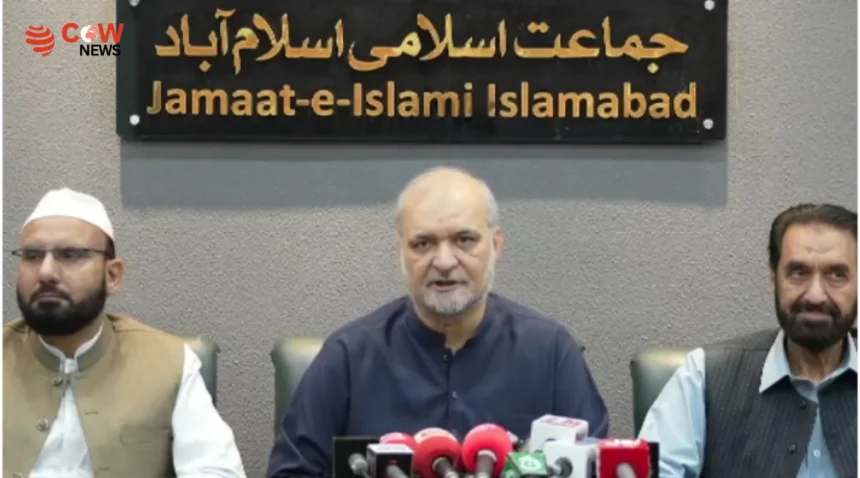
ISLAMABAD(The COW News Digital) Jamaat-e-Islami (JI) chief Hafiz Naeemur Rehman has announced that his party will continue its campaign against the petroleum levy, saying supporters will enter Islamabad from different directions on September 20 to press the government to withdraw the levy.
Addressing a press conference in Islamabad, Hafiz Naeem said the public had effectively labelled the petroleum levy as an unjust additional tax and demanded that the government abolish it.
He said JI had presented what he described as practical proposals to the government for providing relief to consumers. According to the JI chief, reducing the interest rate by three percentage points could save the country around Rs1.7 trillion.
He also questioned why the government had not taken steps to reduce interest rates and urged Prime Minister Shehbaz Sharif to explain the policy.
Hafiz Naeem said his party would not withdraw its demands under any circumstances. He claimed that protests and sit-ins were already being held in 36 cities and announced that JI supporters would converge on Islamabad from multiple directions on September 20.
He warned that if the government continued to delay the matter without taking meaningful action, JI could end negotiations.
The JI chief also criticised power-sector agreements, particularly contracts with independent power producers (IPPs), arguing that consumers continue to bear capacity-payment costs through their electricity bills.
He called for the details of IPP agreements to be made public and alleged that major political parties, including the PML-N, PPP and PTI, shared responsibility for the existing power-sector problems. These allegations were made by Hafiz Naeem during the press conference.
On political matters, the JI chief said his party would attend an All Parties Conference if invited by PTI. He also said JI considers PTI founder Imran Khan a political prisoner.
Hafiz Naeem added that his party remained in contact with opposition groups while continuing its separate political campaign over fuel prices, electricity costs and economic relief.