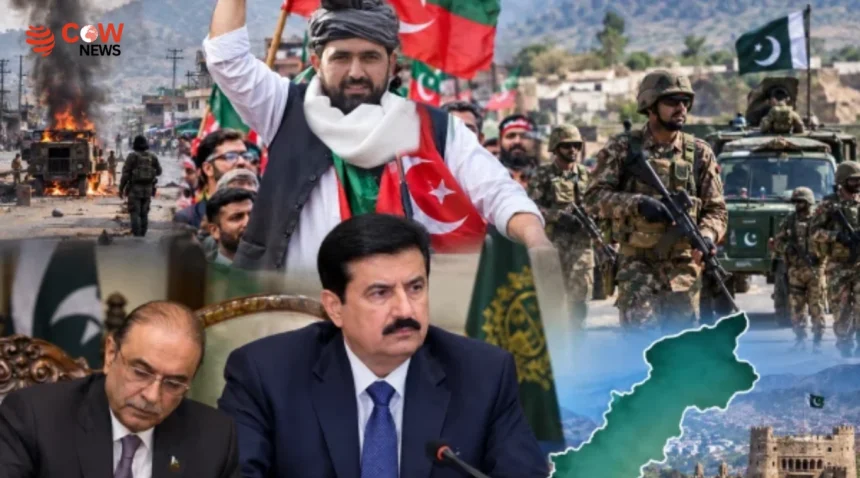
PESHAWAR(The COW News Digital) Khyber Pakhtunkhwa has entered a new administrative phase following the imposition of emergency and governor’s rule, with an 11-member Advisory Council established to assist Governor Faisal Karim Kundi in managing provincial affairs.
President Asif Ali Zardari approved the measures on October 11 under Articles 232 and 234 of the Constitution of Pakistan, following recommendations from the federal government. The decision transfers provincial executive responsibilities to the governor under the new administrative arrangement. The federal government has justified the move by citing security concerns and alleged shortcomings in the provincial government’s counterterrorism efforts.
The formation of the Advisory Council is among the most significant developments following the announcement. The council will assist Governor Kundi in overseeing provincial administration, with members assigned responsibilities covering key departments.
According to the government’s announcement, the council includes representatives responsible for finance, home affairs, law, education, health, energy, industries, communications, religious affairs, information, and minerals.
The new arrangement is intended to ensure continuity in government operations while the province remains under governor’s rule. A separate secretariat has also been established to oversee administrative affairs in 12 districts that will come directly under the federal government, according to the official announcement.
The practical impact of these changes will depend on subsequent administrative orders, the implementation of government policies and any legal challenges that arise.
The federal government has also authorised the deployment of Pakistan Army personnel and resources to assist the civil administration in maintaining law and order, according to the supplied report.
The stated objectives include protecting citizens, safeguarding government installations and supporting security operations against militant threats.
However, military assistance to civilian authorities and the imposition of governor’s rule are separate measures. Their legal authority, operational scope and duration must be assessed under the relevant constitutional provisions and official orders.
The move comes amid continuing security challenges in the province, where federal authorities have called for stronger coordination between law enforcement agencies and the provincial administration.
The emergency has been proclaimed under Article 232, while governor’s rule has been imposed under Article 234. Although both provisions address exceptional circumstances, they serve different constitutional purposes.
Article 232 concerns emergencies involving threats to national security, including internal disturbances beyond a provincial government’s capacity to control. Article 234 addresses situations in which the constitutional machinery of a province is considered unable to function as required.
The Constitution also provides procedures for parliamentary consideration and limits on the duration of such proclamations. Article 234, for example, provides for parliamentary approval and sets a maximum duration of six months for a proclamation under that provision. 【turn656767search2】【turn656767search6】
These constitutional requirements could become central to any legal challenge against the measures.
Pakistan Tehreek-e-Insaf (PTI) has rejected the federal government’s decision, describing it as an attack on the province’s democratic mandate and autonomy.
The federal government, meanwhile, maintains that the measures are necessary to address security concerns and strengthen counterterrorism efforts.
The competing positions have placed constitutional authority, provincial autonomy and responsibility for combating militancy at the centre of the dispute.
For now, the immediate questions concern how the Advisory Council will administer provincial departments, how security operations will be coordinated and whether the emergency measures will face legal challenges.
The coming days are expected to clarify how the new administrative framework operates and what consequences it will have for governance, public services and political relations between Islamabad and Khyber Pakhtunkhwa.