
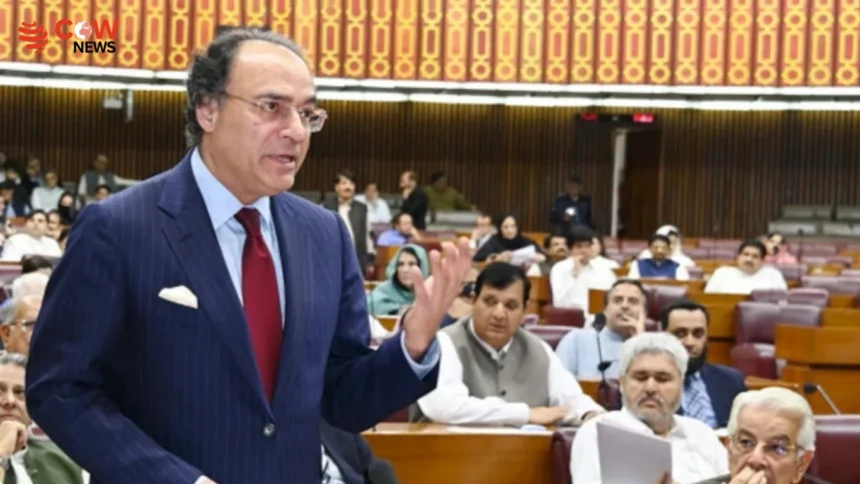
National ( The cow news digital ) Pakistan’s Finance Minister Muhammad Aurangzeb presented a federal budget worth Rs18.77 trillion for the fiscal year 2026-27 in the National Assembly on Thursday, outlining extensive fiscal targets, tax reforms, and development priorities amid political protests from opposition lawmakers.
The total federal expenditure has been estimated at Rs18,771 billion, with a significant portion allocated to debt servicing, defense, development projects, and social welfare programs. According to the budget documents, Rs8,054 billion has been earmarked for interest payments alone, reflecting continued pressure from public debt obligations.
Finance Minister Aurangzeb described the budget as part of the government’s ongoing economic reform agenda, emphasizing macroeconomic stability, export-led growth, and fiscal discipline. He said the administration is working to reduce the burden on salaried individuals while broadening the tax base.
Among key announcements, the government proposed a 7 percent increase in salaries and pensions for government employees, alongside adjustments in income tax slabs to provide relief to the salaried class. Tax rates for various income brackets have been reduced, with the aim of increasing disposable income and easing inflationary pressure on households.
On the development side, the Public Sector Development Programme (PSDP) has been set at Rs3,675 billion, focusing on infrastructure, energy, water resources, and urban development. Major allocations include Rs365 billion for transport and communication projects, including motorways, rail upgrades, and port development initiatives.
Defense spending has been set at Rs3,000 billion, which the government described as a priority given regional security challenges. The finance minister reiterated that strengthening national defense remains a cornerstone of state policy.
The budget also introduces notable tax policy changes. The super tax has been eliminated for six sectors, while corporate tax rates have been reduced from 28 percent to 27 percent to encourage business expansion and investment. In addition, withholding taxes on online shopping, digital transactions, and international payments have been reduced or eliminated in several categories to support digital commerce.
For the digital economy, the government announced a withholding tax on social media and content creator income, including earnings from platforms such as YouTube, Facebook, Instagram, and TikTok, to be collected through financial institutions at the time of transactions.
Social welfare remains a major component of the budget, with Rs2,680 billion allocated to the Benazir Income Support Programme (BISP), expected to benefit approximately 12 million families. Funds have also been allocated for housing schemes, education, healthcare, and youth skill development programs.
In the energy sector, subsidies are being restructured, with reductions in power sector support and targeted relief for electricity distribution companies and regional tariff adjustments. The government also plans to phase out certain petroleum subsidies while maintaining support for renewable energy and electric mobility initiatives.
The budget further proposes new duties on imported vehicles, particularly large engine SUVs and luxury electric cars, while maintaining incentives for domestic electric motorcycles, rickshaws, and buses.
Economic projections suggest GDP growth of 4 percent, inflation at around 8.2 percent, and a fiscal deficit of 3.6 percent of GDP for the coming year. Officials said these targets reflect cautious optimism amid global economic uncertainty.
Analysts say the budget focuses on balancing fiscal consolidation with targeted relief measures, while emphasizing exports, industrial expansion, and digital economy growth as key drivers of future stability.