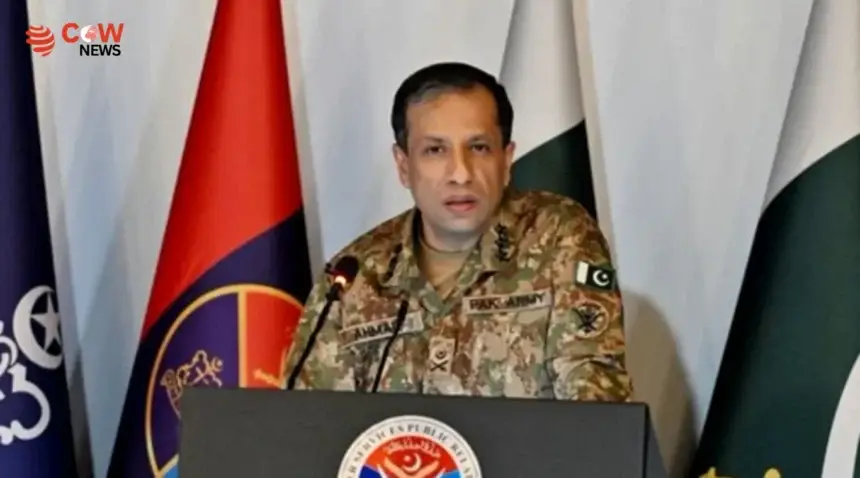
Islamabad (The COW News Digital)Pakistan’s military spokesperson, Lieutenant General Ahmed Sharif Chaudhry, has said that the country’s armed forces have maintained a presence in Saudi Arabia across multiple fields and capabilities for decades, describing the Mecca Joint Defence Agreement as a continuation of longstanding defence cooperation rather than a newly formed alliance.
In an interview with US broadcaster CNN, the Director General of Inter-Services Public Relations (ISPR) discussed the agreement’s objectives, its potential military implications and Pakistan’s diplomatic efforts to help end the conflict between the United States and Iran.
According to excerpts of the interview, Chaudhry emphasised that any implementation of the defence agreement and its resulting actions would be strictly defensive in nature.
The ISPR chief said decisions concerning the deployment of forces, the selection of units and their operational employment would rest with the relevant operational commanders.
He did not specify which Pakistani military units might be deployed or outline a detailed operational framework under the agreement.
His remarks indicated that the practical implementation of the arrangement would depend on military assessments and operational requirements, while remaining within its stated defensive purpose.
Chaudhry described the Mecca Joint Defence Agreement as a mechanism intended to strengthen regional stability amid emerging security challenges.
He said the agreement would provide a collective defensive capability to deter and counter potential threats.
According to the ISPR chief, an attack on one participating country would be treated as an attack on all, a principle intended to discourage hostile actions by increasing the prospect of a coordinated response.
He also stressed that the agreement was not designed to categorise countries as friends or enemies, but was intended to protect Saudi Arabia.
Pakistan’s longstanding defence relationship with Saudi Arabia has included cooperation across various military fields. The latest comments underline Islamabad’s stated commitment to the kingdom’s security while emphasising the defensive character of the agreement.
Chaudhry also addressed Pakistan’s efforts to help bring an end to the conflict involving the United States and Iran.
He said Islamabad had previously worked to reduce differences between the parties and would continue pursuing diplomatic initiatives to support a peaceful resolution through negotiations.
Pakistan, he added, did not want the conflict to spread further across the region.
The military spokesperson described Pakistan’s role in efforts to secure a ceasefire as that of an impartial mediator, saying the country’s primary interest lay in promoting regional peace and stability.
He said Islamabad had communicated to its partners and friendly countries that further expansion of the war would benefit no one.
Pakistan’s stated approach combines its defence cooperation with Saudi Arabia and diplomatic engagement aimed at preventing a wider regional confrontation.
Chaudhry’s comments highlight the importance Islamabad places on Saudi security while continuing to advocate dialogue between Washington and Tehran.
As regional tensions persist, Pakistan’s ability to maintain communication with its partners and support negotiations could remain an important element of its diplomatic efforts.
The remarks, however, do not establish the precise military arrangements that may follow under the defence agreement or indicate whether further deployments have been formally approved.