Islamabad (The COW News Digital): Prime Minister Shehbaz Sharif has warned that any attempt to block Pakistan’s water supply would be considered an act of war, declaring water a national red line amid continuing tensions over the Indus Waters Treaty with India.
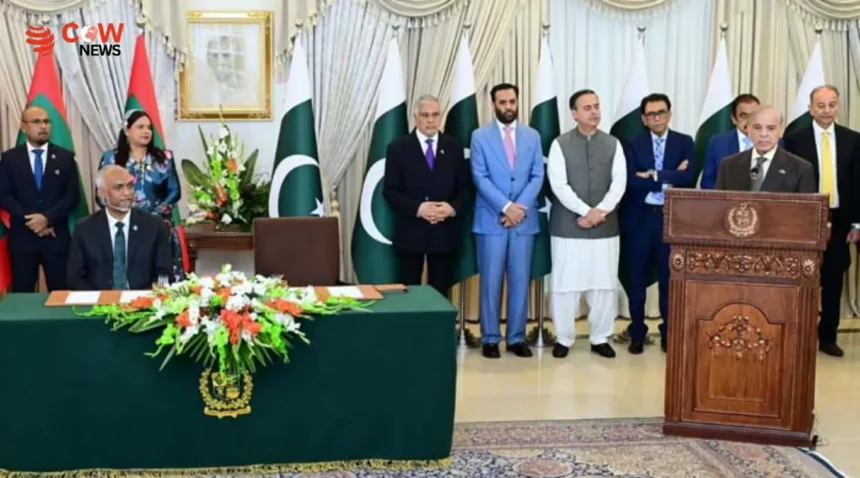
The prime minister made these remarks during a ceremony in Islamabad marking the exchange of memorandums of understanding (MoUs) between Pakistan and the Maldives. Maldivian President Dr Mohamed Muizzu also attended the event, which highlighted growing cooperation between the two countries across several sectors.
Shehbaz Sharif emphasized that Pakistan would not accept unilateral measures affecting its water rights. He described India’s decision to suspend the Indus Waters Treaty unilaterally as unacceptable and stressed that all countries must honour internationally recognised agreements and fulfil their obligations under international law.
“Water is our red line, and any attempt to stop Pakistan’s water will be considered an act of war,” the prime minister said, reiterating Islamabad’s position on the protection of its water resources.
The statement underscores Pakistan’s concerns over the potential consequences of restrictions on water flows, particularly given the country’s dependence on the Indus River system for agriculture, food production and livelihoods. The treaty has historically provided a framework for sharing the waters of the Indus basin between Pakistan and India.
During the meeting, the prime minister also highlighted the longstanding relationship between Pakistan and the Maldives, noting that bilateral ties had strengthened through cooperation in multiple fields, including trade, economic development and defence.
He said a significant number of Maldivian students were studying at Pakistani educational institutions. Pakistani doctors and allied medical professionals were also contributing to healthcare services in the Maldives, reflecting the practical benefits of cooperation between the two nations.
Shehbaz Sharif reaffirmed Pakistan’s willingness to support the Maldives in meeting its additional requirements and expanding collaboration in areas of mutual interest.
The prime minister also reiterated Pakistan’s support for the Palestinian people, saying Islamabad would continue to uphold its principled position in favour of an independent and sovereign Palestinian state. He noted that the Maldives also strongly supported the Palestinian cause.
President Muizzu, meanwhile, said Pakistan and the Maldives had maintained diplomatic relations for 60 years, built on mutual understanding and cooperation. He expressed his country’s commitment to strengthening partnerships in education, healthcare, trade and other important sectors.
The Maldivian president also expressed optimism about the Pakistan-Maldives Business Forum, saying it could create fresh opportunities for commercial engagement and economic cooperation. He highlighted the importance of youth exchange programmes and called for expanded exchanges between delegations from both countries.
Muizzu further stressed the need to benefit from emerging technologies, particularly artificial intelligence and digitalisation, describing technological advancement as an important requirement for future development.
The discussions reflected a shared commitment to strengthening bilateral relations while addressing wider regional and international issues. Pakistan’s firm position on water security, however, remained a central message of the prime minister’s remarks, as Islamabad reiterated that safeguarding its water rights was essential to national security.