
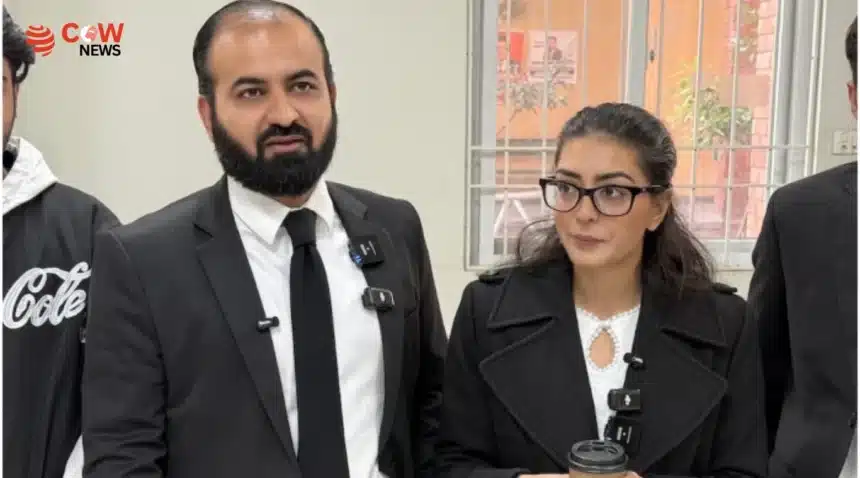
ISLAMABAD(The COW News Digital) The Supreme Court has granted bail to lawyer Imaan Mazari and her husband, Hadi Ali Chatha, while suspending the sentences handed down to them by a trial court in a case concerning social media posts.
A Supreme Court bench approved bail for both accused against surety bonds of Rs200,000 each. The court ordered that the relief would remain effective until the final decision of the Islamabad High Court in the pending case.
The development follows a trial court verdict in January 2026, under which Mazari and Chatha were each sentenced to a total of 17 years in prison in connection with social media posts.
According to the trial court order, both were convicted under multiple provisions of the Prevention of Electronic Crimes Act (PECA).
Under Section 9 of PECA, the court had sentenced each accused to five years in prison and imposed a fine of Rs5 million.
They were also handed 10-year prison terms each under Section 10, along with fines of Rs30 million each.
Additionally, both were sentenced to two years in prison under Section 26-A, with a fine of Rs1 million each.
During the Supreme Court hearing, Justice Naeem Akhtar Afghan observed that both Mazari and Chatha were lawyers and said the court was mindful of their professional status. He also advised them to observe courtroom decorum, noting that lawyers were expected to maintain a distinction between professional conduct and that of an ordinary litigant.
The Supreme Court’s order means that the sentences imposed by the trial court will remain suspended while the Islamabad High Court proceedings continue.
The case has attracted significant attention because it involves criminal proceedings arising from social media activity and the application of Pakistan’s cybercrime laws.
The latest ruling does not constitute a final determination of the underlying case. The Islamabad High Court is still expected to decide the matter pending before it, while the Supreme Court’s bail order provides temporary relief to the two accused.
The proceedings are being closely followed because of their implications for the application of PECA provisions to online speech and social media content in Pakistan.