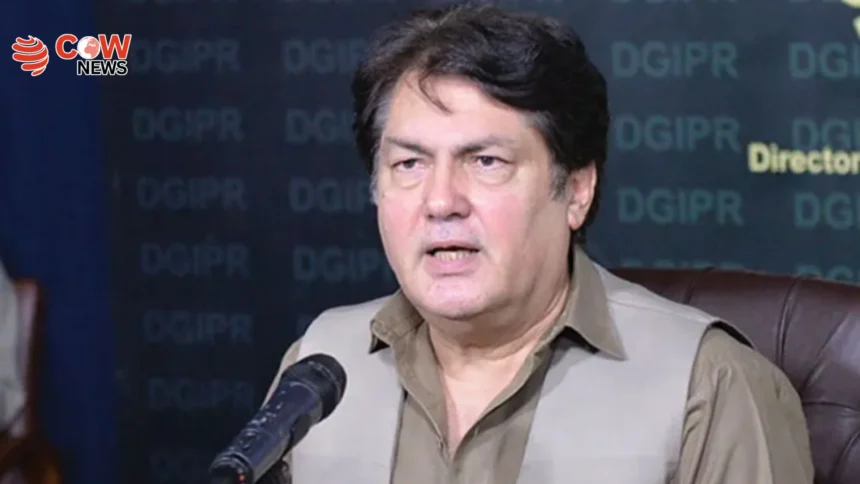
National ( The cow news digital ) Former information adviser of Khyber Pakhtunkhwa, Barrister Muhammad Ali Saif, has said that Pakistan needs alternative leadership beyond both the government and the opposition to address the country’s ongoing political challenges.
In a recent statement, Barrister Saif said that the current political environment reflects a failure on both sides of the divide, where neither the ruling setup nor the opposition is effectively fulfilling its responsibilities. He argued that the political deadlock in the country can only be resolved through meaningful national dialogue.
He emphasized that a comprehensive national consensus is necessary to move the country forward, stressing that continued confrontation between political forces is harming governance and public trust. According to him, dialogue and political reconciliation are the only viable paths to stability.
Barrister Saif also pointed out that the opposition has not been able to play its role effectively in the current political situation. He said this gap has created a vacuum that requires new thinking and leadership approaches outside traditional political structures.
He further stated that a National Dialogue Committee event is scheduled to take place in Karachi, where political and social leaders are expected to discuss ways to prioritize national interest over personal and political differences. He said such platforms are essential for reducing polarization and improving political cooperation.
The former adviser added that Pakistan’s major challenges, including governance issues and economic instability, cannot be resolved without sustained negotiations and political harmony. He reiterated that engagement between all stakeholders is critical for ensuring long-term stability.
Barrister Saif has previously been associated with efforts to improve communication between political actors and state institutions, often advocating for dialogue-based solutions to political tensions. His recent remarks continue to reflect a consistent call for reconciliation and institutional cooperation.
Read more
- US Envoy Backs Israel’s Claim to Wider Middle East
- Pakistan, Taliban, and Afghanistan: The Complex Triangle of Influence
Political observers note that his statement comes at a time when Pakistan’s political environment remains highly polarized, with ongoing tensions between major political parties and institutions. Analysts believe that calls for alternative leadership reflect growing frustration with the existing political framework.
The debate over political restructuring and dialogue is expected to continue as various stakeholders push for different approaches to resolving the country’s governance challenges.