
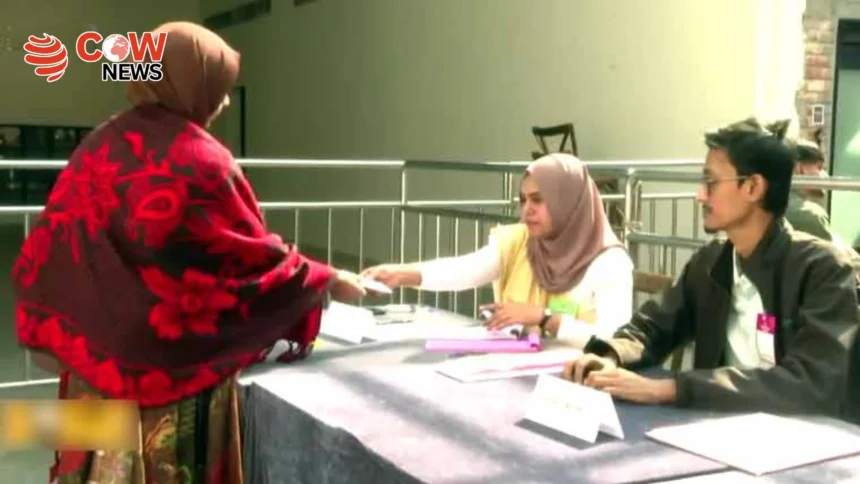
Dhaka, Bangladesh (The COW News Digital) Bangladesh’s highly anticipated general election is underway, with voters across the nation turning out to choose a new government in what has become a closely watched and competitive political contest. More than 127.6 million eligible voters are registered to cast their ballots for 300 parliamentary seats, with intense competition between major political coalitions, particularly the Bangladesh Nationalist Party (BNP) and the alliance led by Jamaat Islami.
The election process began amid heightened public interest and comprehensive security arrangements. To form a government, a party or coalition must secure at least 151 of the 300 seats in the Jatiya Sangsad (National Parliament). Analysts describe the race as one of the most unpredictable in recent years, with both sides campaigning vigorously on issues ranging from economic recovery to governance and national stability.
Leading the BNP ticket is Tarique Rahman, son of former Prime Minister Khaleda Zia, who is projected by party supporters as a strong challenger for the premiership. The alliance led by Jamaat Islami has also nominated Shafiqur Rahman as its prime ministerial candidate, presenting a united front to attract conservative and rural voters.
In addition to the BNP and Jamaat Islami alliance, other parties are actively contesting the polls. These include the National Citizens Party and Jatiya Party, among others. Together, 50 political parties have fielded candidates in the election, along with 249 independent contenders, bringing the total number of candidates to 1,981.
One notable development in this election cycle is the involvement of the National Citizens Party, which includes members formerly aligned with the ruling Awami League. The party’s founder, prominent political figure Zain Zia, played a controversial role in the August 2024 upheaval that reshaped Bangladesh’s political dynamics. Despite this, the Awami League itself is not formally contesting the election, as its candidates are barred from participation under current legal restrictions.
Security across Bangladesh has been significantly increased to ensure a peaceful electoral process. The government has deployed the military and nearly 900,000 security personnel nationwide to manage polling duties and address any potential unrest, particularly in urban centers and border regions.
As results begin to trickle in, political observers and international stakeholders are closely monitoring the voting trends and early indicators of seat distributions. Voter turnout figures, the performance of independent candidates, and how well each coalition mobilizes its base are expected to shape the post-election political landscape.
With democratic processes at the heart of the event, Bangladesh’s general election is being observed as a pivotal moment for the country’s future governance and stability.