
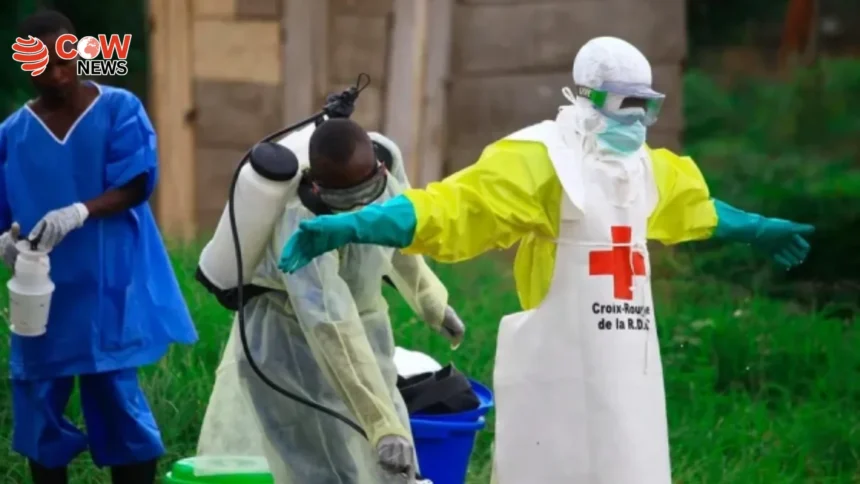
KINSHASA(The COW News Digital) Health authorities in the Democratic Republic of Congo have confirmed a new Ebola outbreak that has already claimed at least 65 lives, raising fears of a possible cross-border health emergency in Central Africa.
According to Africa Centres for Disease Control and Prevention (Africa CDC), 246 suspected cases have been recorded in Congo’s northeastern Ituri province, where the outbreak is currently concentrated. Medical teams are investigating whether the strain involved is Ebola Zaire, the deadliest known variant of the virus.
The outbreak is centered in the Mongbwalu and Rwampara health zones, areas located close to the borders of Uganda and South Sudan. Public health officials have warned that the highly contagious disease could spread beyond Congo’s borders if immediate containment measures are not strengthened.
Uganda has already confirmed one Ebola-related death, intensifying regional concerns about the virus moving through border communities with frequent population movement. Health experts say surveillance and rapid response systems are now critical to preventing a wider humanitarian crisis.
Africa CDC stated that emergency response teams are being deployed to affected areas to trace contacts, isolate suspected patients, and support local treatment centers. International health organizations are also coordinating with Congolese authorities to provide medical supplies, protective equipment, and laboratory support.
Ebola is a severe and often fatal viral disease that spreads through direct contact with infected bodily fluids or contaminated surfaces. Symptoms include fever, vomiting, diarrhea, internal bleeding, and severe weakness. Previous outbreaks in Congo have demonstrated how quickly the virus can overwhelm fragile healthcare systems, especially in conflict-affected regions.
The Democratic Republic of Congo has experienced several Ebola outbreaks over the past decade, including major epidemics that resulted in thousands of deaths. However, health experts warn that ongoing insecurity in eastern Congo continues to complicate response efforts, making disease surveillance and medical access more difficult.
Read more
- US Envoy Backs Israel’s Claim to Wider Middle East
- China Urges Global Support for Sustainable Sudan Solution
Regional governments are now increasing health screenings at border crossings while urging residents to report symptoms immediately. Public awareness campaigns have also been launched to educate communities about prevention measures and the importance of early treatment.
Global health agencies remain on high alert as fears grow that the outbreak could escalate into a wider regional emergency if not quickly contained. Authorities say the coming weeks will be crucial in determining whether the virus can be brought under control before spreading further across neighboring countries.