
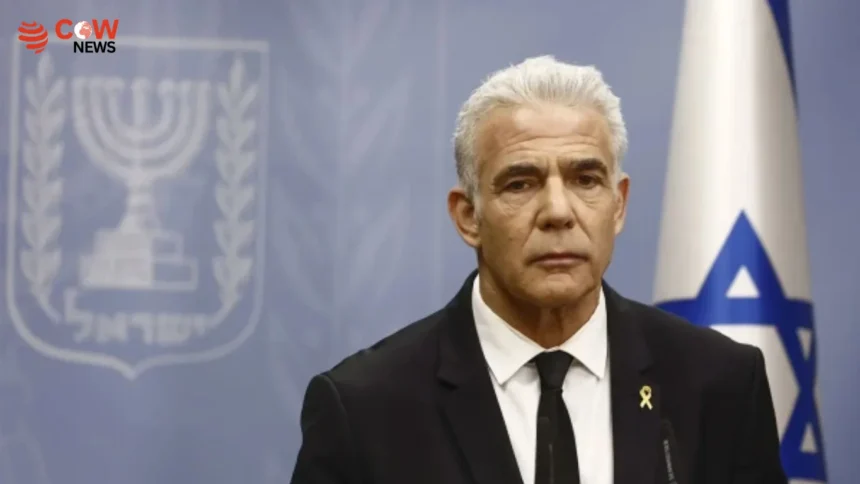
World ( The cow news digital ) Israeli opposition leader Yair Lapid has launched a sharp attack on Prime Minister Benjamin Netanyahu, calling Israel’s approach toward Iran a strategic failure and questioning the outcomes of its regional policy amid ongoing diplomatic developments involving the United States and Iran.
In a statement shared on social media, Lapid said that Israel has failed to achieve any of its major objectives during the recent conflict and accused the government of mismanaging its Iran policy. He argued that despite years of confrontation and pressure, Iran’s governing structure remains intact and its military capabilities have not been decisively weakened.
Lapid further claimed that Iran continues to maintain its missile program and retains the technical ability to revive and advance its nuclear ambitions in the future. He described this situation as evidence of what he called a “complete failure” of Netanyahu’s leadership strategy.
The opposition leader also made a controversial remark, alleging that Netanyahu’s policies have reduced Israel’s strategic independence, turning it into what he described as a “client state” of the United States. His comments reflect growing political tension within Israel over the direction of foreign policy and security strategy.
Lapid added that no amount of public relations campaigns, media messaging, or digitally produced content could conceal what he views as the government’s shortcomings in handling the Iran file.
His remarks come at a sensitive time, as international discussions reportedly continue regarding a possible agreement between the United States and Iran. Former U.S. President Donald Trump has recently suggested that a deal may be nearing completion, though details remain unclear and subject to conflicting interpretations.
Read more
- Pakistan, Taliban, and Afghanistan: The Complex Triangle of Influence
- Trump Hopes Iran Talks Succeed, Warns Against Midnight Hammer
The evolving geopolitical landscape has intensified debate within Israel’s political sphere, with opposition figures increasingly questioning the effectiveness of the government’s long-standing hardline stance on Iran.
As diplomatic efforts progress internationally, Israel’s internal divisions over security strategy and regional alliances appear to be deepening, adding further complexity to an already volatile Middle East situation.