
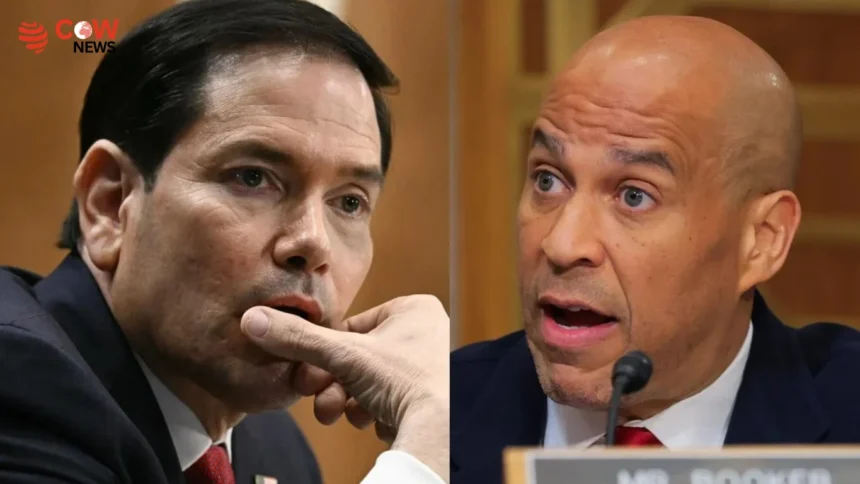
World ( The cow news digital ) A heated exchange unfolded in the United States Senate during a policy discussion on Iran, where Democratic Senator Cory Booker sharply questioned Secretary of State Marco Rubio over Washington’s renewed diplomatic engagement with Tehran.
The debate centered on the United States’ approach toward a possible agreement with Iran amid ongoing regional tensions and disputes over the country’s nuclear programme. Senator Booker criticized the administration’s stance, questioning why the US appeared to be reconsidering negotiations on a deal that was previously rejected or heavily criticized by American policymakers.
During the Senate session, Booker argued that the shift in policy raised concerns about consistency in US foreign policy. He also pointed to heightened tensions in the Middle East, including developments involving the Strait of Hormuz, suggesting that the security environment made renewed diplomacy more complex.
In a pointed remark, the senator questioned whether Washington was now under pressure to return to a framework it had earlier dismissed, reflecting broader political divisions over how to engage with Iran.
Responding to the criticism, Secretary of State Marco Rubio rejected the suggestion that the United States was acting from a position of weakness. He described ongoing discussions with Iran as part of a complex diplomatic and technical process rather than a concession-driven negotiation.
Rubio emphasized that talks related to Iran’s nuclear programme require detailed technical engagement involving experts and cannot be resolved quickly through political declarations alone. According to him, such negotiations may extend over weeks or even months before any viable framework can be established.
He further stated that Iran has recently shown willingness to engage on certain issues it had previously avoided, particularly regarding aspects of uranium enrichment. However, he stressed that significant gaps remain between the two sides.
The exchange highlighted deep political divisions in Washington over how to approach Iran, with critics warning against perceived concessions and supporters arguing that diplomacy remains the most viable path to preventing further escalation.
Read more
- Read moreImran Khan and the Politics of Idolization
- Pakistan, Taliban, and Afghanistan: The Complex Triangle of Influence
The discussion comes at a time when US-Iran relations remain strained, with broader geopolitical implications across the Middle East. Lawmakers on both sides continue to debate the balance between pressure and engagement as Washington reassesses its long-term strategy in the region.
The Senate session underscored that Iran policy remains one of the most contentious foreign policy issues in American politics, with no clear consensus on the path forward.