
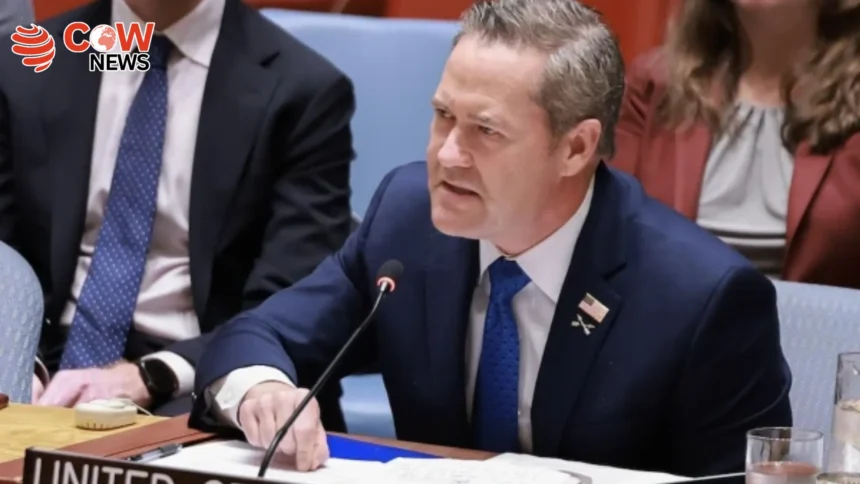
New York(The COW News Digital)The United States has defended its controversial military operation in Venezuela during an emergency meeting of the United Nations Security Council, convened following the arrest of Venezuelan President Nicolás Maduro. Speaking at the session, the US ambassador argued that Washington acted only after diplomatic efforts failed, insisting that the operation was lawful and targeted, not an act of war against Venezuela or its people.
Addressing the council, US Ambassador Mike Waltz said that President Donald Trump had explored diplomatic channels and offered Venezuela opportunities to de-escalate tensions. According to Waltz, these proposals were rejected by Maduro, leaving the United States with no alternative but to act. “The United States is not at war with Venezuela or its citizens,” Waltz stated. “We are not seeking occupation or regime change, but accountability.”
The ambassador claimed the operation was conducted to bring Maduro and his wife to justice over alleged links to narcotics trafficking and what he described as “narco-terrorism.” He added that the action was necessary to protect American citizens from the flow of illegal drugs and organized crime networks operating across borders. Waltz emphasized that Washington’s objective was to promote peace, freedom, and long-term stability for the Venezuelan people.
Despite the US defense, the emergency session revealed Washington’s growing isolation on the issue. Several members of the Security Council, including both allies and rivals, criticized the operation as a clear violation of international law and national sovereignty. Many delegations warned that such actions set a dangerous precedent that could undermine the global rules-based order.
A statement from UN Secretary-General António Guterres was read aloud during the meeting, in which he expressed serious concern over the use of force without broad international authorization. The statement described the operation as a risky escalation and urged all parties to respect the UN Charter and international legal frameworks.
Russia, China, Brazil, Colombia, Cuba, and a number of other countries strongly condemned the US action, labeling it an act of aggression. European allies, while more measured in tone, also voiced unease and stressed the importance of resolving disputes through diplomacy rather than unilateral military measures.
Analysts say the Security Council debate highlights deep divisions over US foreign policy in Latin America and raises questions about future regional stability. With Venezuela already facing severe political and economic challenges, critics fear the operation could further inflame tensions across the continent.
As diplomatic fallout continues, the international community is watching closely to see whether the crisis leads to renewed negotiations or further confrontation, with many urging restraint and a return to dialogue.