
By Amjad Hadi Yousafzai
( The cow news digital ) Every letter carries its own world, and at times a single letter can reflect the condition of an entire era. Today, among us, one such letter seems to echo repeatedly—the letter “T”. It reflects both the beginning and the end of many of our collective problems. Yet, this letter is not limited to destruction; it can also serve as a powerful symbol of construction and progress.
Ordinarily, education is given the highest importance, but in reality, priority should be given to training and character-building. A child enters school at around the age of five, while the foundation of his personality is laid much earlier at home. If a household fails to instill values such as ethics, respect, honesty, and responsibility, then schools, seminaries, and other educational institutions can only impart information—not character. Basic moral and religious education in early learning institutions forms the foundation of personality, while universities develop intellectual depth, research capability, and critical thinking. Together, they shape both the individual and society. When this balance is missing, societies end up producing information without character, knowledge without wisdom, and learning without understanding.
Education, once a ladder for national progress, has increasingly become a means to pass examinations. Depth of thought has diminished, while the race for grades has intensified. Thinking minds are becoming fewer, while rote learners are increasing. When education weakens, the future inevitably begins to shake.
In earlier times, character was built within homes. Today, personalities are increasingly shaped by screens. Parents chase time, while children grow up deprived of attention. The absence of proper upbringing affects not just individuals but entire generations.
Commerce and the economy are also not immune to this influence. Honesty is gradually being replaced by cleverness, and quality by advertisement. Trust—the foundation of trade and economic systems—is steadily weakening. When commerce is stripped of ethics and humanity, economies may continue to function, but blessing and trust disappear.
The field of law, which is meant to represent justice, sometimes becomes entangled in technicalities, creating distance between truth and justice. When law becomes merely a skill of winning cases rather than delivering justice, courts may issue decisions, but the satisfaction of justice is often missing.
Publishing and print media are also undergoing transformation. The pen, once a symbol of responsibility, now competes with speed at the cost of depth. Books, newspapers, and magazines, once tools of intellectual development, are increasingly losing seriousness in the race for urgency and sensationalism.
The same is true for journalism. Once regarded as the pursuit of truth and the voice of public awareness, journalism now often turns news into perception rather than verified reality. When journalism loses balance, society drifts away from truth despite being surrounded by information.
Medicine and healthcare represent one of the most sensitive responsibilities of humanity. It was once considered not just a profession but a symbol of service, compassion, and sacrifice. A physician treated not only the body but also strengthened the patient’s spirit. However, when treatment turns into business, tests outweigh diagnosis, and profit replaces service, trust begins to erode. True medicine is not merely the elimination of disease; it is the restoration of life and dignity.
Health itself is not limited to hospitals and medicines. It is a combination of clean environment, balanced nutrition, mental peace, and timely access to care.
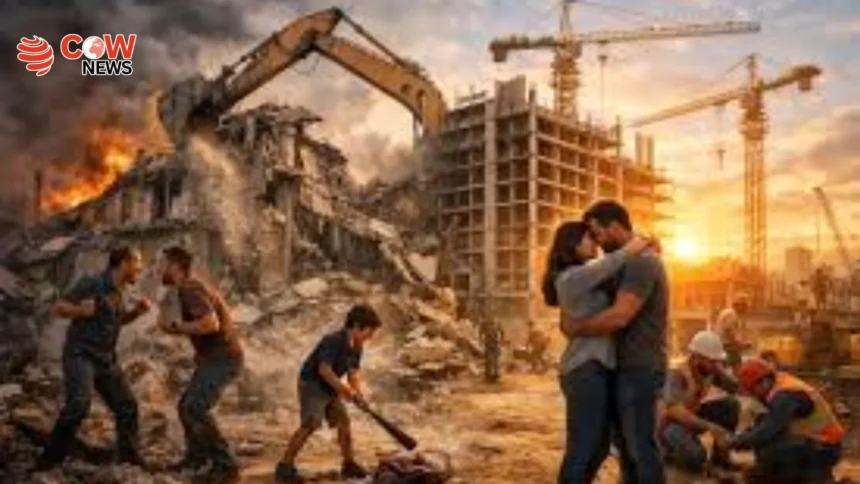
Construction, which should symbolize progress, is witnessing mixed realities. While skyscrapers continue to rise, issues related to planning, quality, and integrity are creating new social challenges. Real construction is not only about buildings but also about values and human development.
Culture, too, is facing gradual erosion. As societies attempt to modernize, they often drift away from their linguistic and cultural roots. When culture weakens, identity begins to fade.
Politics and governance complete the picture. Speeches are loud, promises are grand, yet outcomes often remain disappointing. When governance shifts from service to power, trust between the state and citizens begins to weaken. Weak municipal systems further exacerbate urban challenges such as sanitation, water supply, drainage, and basic civic services, while strong local governance can address these issues efficiently and restore public confidence.
Elections, the lifeblood of democracy, reflect public trust and transparency. Fair and credible elections strengthen confidence in institutions, while irregularities widen the gap between the state and society, creating unrest.
Diplomacy plays a crucial role in maintaining balance between nations. When conducted wisely, it reduces the likelihood of conflict and opens pathways to peace. History has shown that closed doors increase problems, while dialogue opens solutions. Negotiation is ultimately a test of patience, wisdom, and foresight.
On a personal level, human relationships form the foundation of life. Bonds survive on trust, respect, and empathy. When self-interest dominates relationships, distance grows. A true friend is one who supports in difficult times, reflects honesty, and encourages self-improvement. Strong friendships sustain hope and trust within society.
While institutions and laws exist, implementation remains weak. The recurring question is whether the fault lies in the system or its operators. The truth likely lies somewhere in between.
Overall, society appears trapped in a chain of interconnected weaknesses. Everyone desires change, yet few are willing to initiate it within themselves. We speak of truth but prioritize convenience. Small compromises accumulate into larger crises.
The reality is that the letter “T” does not only stand for destruction. It also represents transformation, cooperation, patience, balance, civilization, humanity, and progress. The difference lies in intention, character, and action.
If we build character and ethics in early education, promote knowledge and research in universities, strengthen training alongside education, restore integrity in trade and economy, uphold truth in journalism, ensure justice in law, revive humanity in healthcare, improve quality in construction, preserve cultural identity, bring wisdom into diplomacy, make governance and local bodies service-oriented, ensure transparency in elections, and restore sincerity in relationships and friendships, then this very “T” can transform from a symbol of destruction into one of construction and development.
Ultimately, nations are not built or destroyed by letters, but by behavior. Within every downfall lies the seed of reconstruction, within every crisis a lesson, and within every letter a hidden power capable of reviving society and economy—provided there is intention, character, and action.