
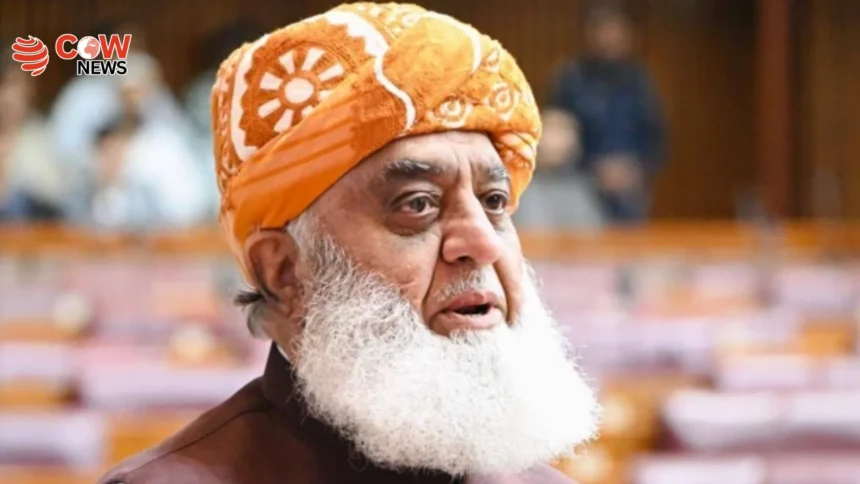
National ( The cow news digital ) Jamiat Ulema-e-Islam (JUI-F) chief Maulana Fazlur Rehman has strongly criticized the security situation and governance in Pakistan, questioning whether the state is merely celebrating military achievements while neglecting rising violence and public suffering.
Speaking on the floor of the National Assembly, he said that two provinces have effectively turned into strongholds of insecurity, where state authority appears to be absent. He raised concerns over ongoing unrest, forced displacement of citizens, and repeated military operations that, according to him, have failed to produce lasting stability.
Fazlur Rehman questioned the government’s priorities, asking whether public life and security were being ignored in favor of political celebrations. He stated that he had repeatedly highlighted deteriorating conditions in parliamentary sessions, but claimed that opposition voices were not being properly broadcast to the public.
Referring to casualties in his political strongholds, he said several party members had been killed over time and cited mass funerals in Bajaur, calling the situation alarming. He argued that continuous operations had not resolved the underlying issues, but instead worsened conditions over time.
The JUI-F leader also criticized economic policies, questioning why fuel prices in Pakistan remain high compared to other countries, even when regional conditions appear similar. He further alleged that key parliamentary decisions are being taken outside the legislature, reducing the National Assembly to a symbolic institution.
He also touched on foreign policy and international relations, referencing past conflicts with India and U.S. involvement in ceasefire efforts. He remarked on global geopolitical dynamics and criticized attempts to award diplomatic achievements without addressing domestic challenges.
Fazlur Rehman expressed concern over constitutional matters, accusing successive governments of weakening parliamentary authority and rolling back reforms. He specifically referred to the 18th Constitutional Amendment, questioning its gradual dilution and the role of political parties in it.
He also criticized governance in relation to education and religious institutions, alleging undue interference and privatization trends. According to him, such policies are eroding trust between the state and religious segments of society.
Calling the current democratic process ineffective, he described the system as weakened and claimed that opposition forces would continue to resist government policies. He also urged opposition members to consider a parliamentary walkout in protest.
His speech highlighted growing political tensions, security concerns, and economic frustrations, reflecting ongoing divisions between the government and opposition in the National Assembly.