

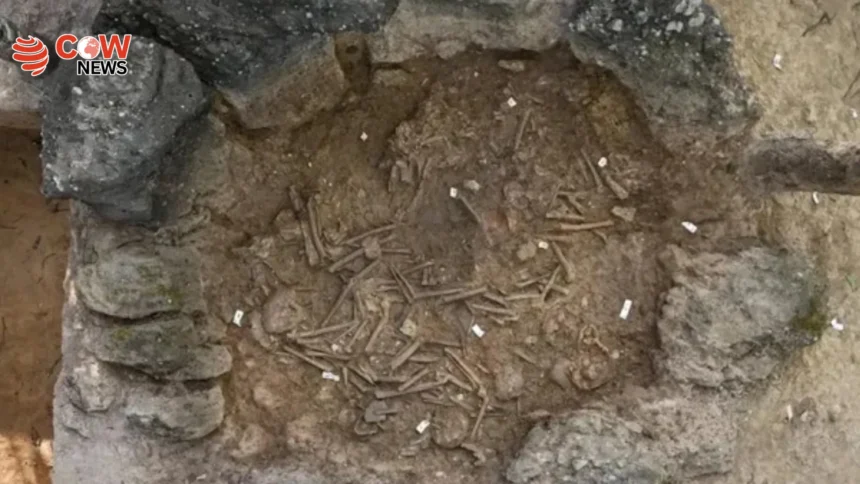
World ( The cow news digital ) Archaeologists in Laos have made a striking discovery in the famous Plain of Jars, uncovering a massive stone vessel containing human remains that has raised new questions about ancient burial practices in Southeast Asia.
The discovery, referred to by researchers as the “Death Jar,” is believed to be one of the largest stone jars ever found in the region. According to archaeologists, the jar contained bones and teeth of at least 37 individuals, making it one of the most significant and unusual findings at the site to date.
The excavation was carried out in a remote forest area within the Plain of Jars, a UNESCO-listed archaeological landscape known for thousands of mysterious stone jars scattered across its terrain. These structures have long puzzled historians, with theories ranging from burial urns to ceremonial containers.
Researchers used radiocarbon dating on the teeth recovered from the site, which indicated that the remains date back to between 890 and 1160 AD. This period corresponds to a time of significant historical activity across Asia and beyond, including the era of Viking expansion in Europe.
The specific jar, now labeled “Jar No. 1” by scientists, measures approximately 1.3 meters in height and around 2 meters in width. Its unusually large size and the dense concentration of human remains inside have made it stand out from other similar structures found in the region.
Lead archaeologist Dr. Nicholas Skopal described the jar as one of the largest ever discovered in Laos, noting that its structure and contents suggest a highly unusual burial or ritual practice. He added that the combination of its size, design, and contents distinguishes it sharply from other jars found across the site.
The “Death Jar” features thick stone walls, a wide base, and a bowl-like shape, which researchers believe may have been intentionally designed for ceremonial or funerary purposes. However, the exact cultural meaning and method of use remain unclear.
Read more
- China Urges Global Support for Sustainable Sudan Solution
- US Envoy Backs Israel’s Claim to Wider Middle East
Experts say the discovery adds an important new layer to the ongoing study of the Plain of Jars, which continues to be one of Southeast Asia’s most mysterious ancient archaeological landscapes.
Further analysis is expected to shed light on the identity of the individuals found inside the jar and the broader historical context of this extraordinary site.