
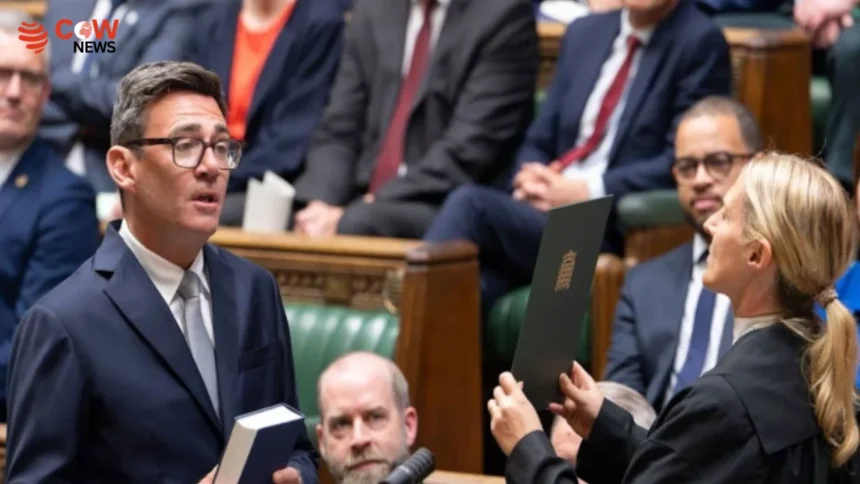
World ( The cow news digital ) In a notable political development in the United Kingdom, prominent Labour Party figure Andy Burnham has officially taken oath as a Member of Parliament in the House of Commons, marking a key step in what political observers describe as a potential path toward the premiership.
According to reports from United Kingdom, Andy Burnham was warmly received by fellow members of the Labour Party upon entering the chamber. The atmosphere inside the House of Commons was described as enthusiastic, with party members welcoming his return with slogans and applause.
During the formal session, Burnham took the traditional parliamentary oath and acknowledged the greetings of fellow lawmakers as he walked through the chamber. He later met Speaker Lindsay Hoyle in a cordial exchange following the ceremony, officially completing the procedural requirements to serve as an MP for the constituency of Macclesfield.
Burnham secured his seat after winning a by-election held on 18 June 2026. The election followed the resignation of Labour MP Josh Simons, who stepped down to allow Burnham to contest the seat. The Labour Party’s National Executive Committee had nominated Burnham for the constituency, paving the way for his return to Westminster politics.
In the by-election, Burnham achieved a decisive victory, securing more than 54 percent of the vote and defeating the Reform UK candidate. His win was seen as a significant political moment for the Labour Party, reinforcing his influence within the party and national politics.
Andy Burnham is a well-known figure in British politics. He has previously served in senior cabinet positions, including Health Secretary, Culture Secretary, and Home Secretary. At present, he also serves as the Mayor of Greater Manchester, where he has gained popularity for his governance style and policy initiatives.
His return to Parliament has sparked renewed discussion about leadership within the Labour Party, with supporters viewing him as a potential future leader. Political analysts suggest that his presence in the House of Commons strengthens his position within internal party dynamics at a crucial time.
Under the UK political system, the Prime Minister is not directly elected by the public. Instead, the leader of the majority party in the House of Commons is invited by the monarch to form a government. If the Labour Party maintains its majority and Burnham emerges as party leader, he could be positioned for the premiership.
As he settles into his parliamentary role, attention now turns to the Labour Party’s internal leadership decisions and future political direction in United Kingdom.