
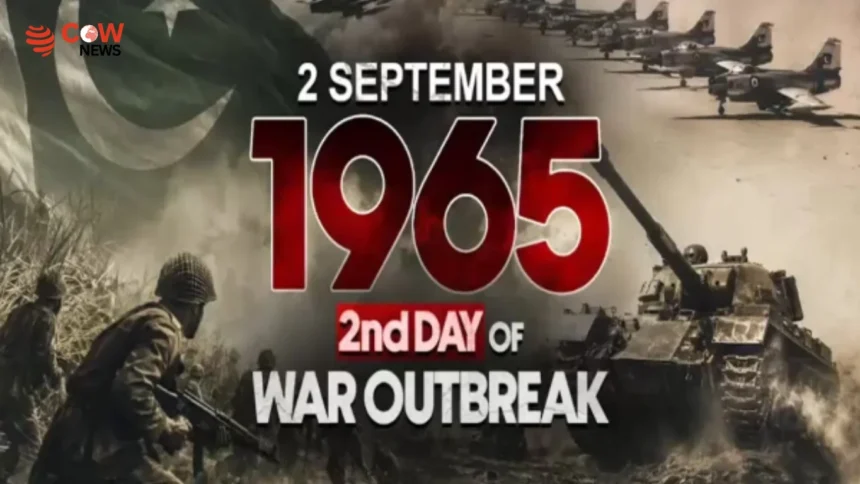
RAWALPINDI(The COW News Digital) On the second day of the September 1965 War, Pakistani armed forces launched powerful counter-offensives across active sectors, inflicting heavy personnel and equipment losses on invading Indian troops while consolidating crucial tactical positions.
The escalation followed explicit war threats from Indian Prime Minister Lal Bahadur Shastri, who publicly acknowledged that Pakistani forces had shot down four Indian Air Force aircraft the previous day. In response, Indian Army Chief General J.N. Chaudhuri convened emergency strategy meetings with senior commanders in Indian-administered Kashmir to recalibrate ground operations.
Addressing the nation, former President Field Marshal Ayub Khan warned New Delhi that its long-standing posture of hostility toward Pakistan and Jammu & Kashmir had brought the region to a critical flashpoint. Ayub Khan reaffirmed Pakistan’s unshakeable resolve to counter Indian aggression decisively and honor its commitments to the Kashmiri people. Echoing these sentiments, former Azad Jammu and Kashmir President Sardar Abdul Qayyum Khan stated that the Indian military had invited its own destruction by initiating unprovoked hostilities.
On the tactical front, military formations were issued emergency warning orders to occupy strategic concentration areas. In Kashmir, Pakistani troops completely wiped out an Indian platoon near Sonamarg while launching relentless artillery and ground strikes against enemy strongholds and vital infrastructure.
The most significant armored breakthrough occurred in the Chhamb sector, where advancing Pakistani units pushed eastward, capturing 15 Indian tanks and taking 150 enemy soldiers as prisoners of war. The dramatic outcome drew serious concern from international observers over India’s dangerous escalation of aerial and ground warfare.