
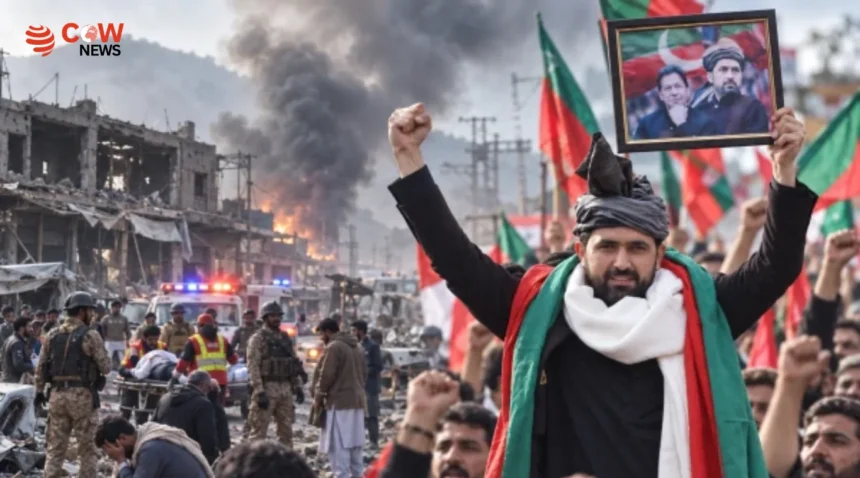
PESHAWAR (The COW News Digital) A renewed wave of terrorism in Khyber Pakhtunkhwa has intensified debate over governance, law enforcement and efforts to disrupt networks that allegedly connect criminal activities with militant financing.
The issue of what officials describe as the “illegal spectrum” and the crime-terror nexus has emerged as a significant security concern in the province. Critics argue that weak action against drug trafficking, smuggling and other illegal economic activities can create financial channels that may be exploited by militant groups.
Security officials have repeatedly emphasised that counterterrorism efforts cannot be limited to military or police operations alone. They have stressed the need to target the wider networks involved in drug trafficking, smuggling, illegal financing and other activities that can support armed groups.
One of the examples cited in this context is the Tirah Valley, where illegal cultivation and trafficking of narcotics have reportedly remained a concern. According to sources cited in the report, approximately 12,000 acres of land across Tirah and Khyber are being used for narcotics cultivation, with a portion of the proceeds allegedly reaching militant elements.
Drug trafficking remains a broader challenge for law enforcement agencies across the province. During the first quarter of 2026, Khyber Pakhtunkhwa Police reportedly seized 5,695 kilograms of hashish, 847 kilograms of crystal methamphetamine, 210 kilograms of heroin and 275 kilograms of opium.
Customs authorities have also reported major seizures linked to smuggling. During a two-week period in July 2026, officials reportedly confiscated smuggled goods and vehicles worth Rs1.163 billion.
These figures highlight the scale of the illegal economy operating across parts of the province and the continuing pressure on law enforcement agencies to prevent such networks from supporting organised crime or militant activity.
The report also refers to repeated warnings by the Director General Inter-Services Public Relations (DG ISPR), who has stressed the importance of addressing illegal economic networks, narcotics, smuggling and financial support as part of a broader counterterrorism strategy. According to this position, improved governance and political support for efforts against militant networks are also necessary for achieving lasting security.
Federal Information Minister Attaullah Tarar has also previously criticised the provincial government over what he described as shortcomings in dealing with the illegal spectrum in Khyber Pakhtunkhwa. The provincial government’s performance in tackling these challenges has consequently become part of the wider political debate over security and governance.
However, claims about links between illegal economic activities and terrorist financing require investigation and evidence on a case-by-case basis. Seizures of narcotics or smuggled goods do not by themselves establish that the proceeds were transferred to militant organisations.
The continuing security situation has nevertheless placed renewed focus on the relationship between law enforcement, governance and counterterrorism. Authorities face the challenge of disrupting criminal networks while strengthening policing, border controls, financial monitoring and administrative capacity across the province.
As security operations continue, the effectiveness of measures targeting narcotics, smuggling and alleged terrorist financing is likely to remain an important part of the debate over Khyber Pakhtunkhwa’s security and governance.