
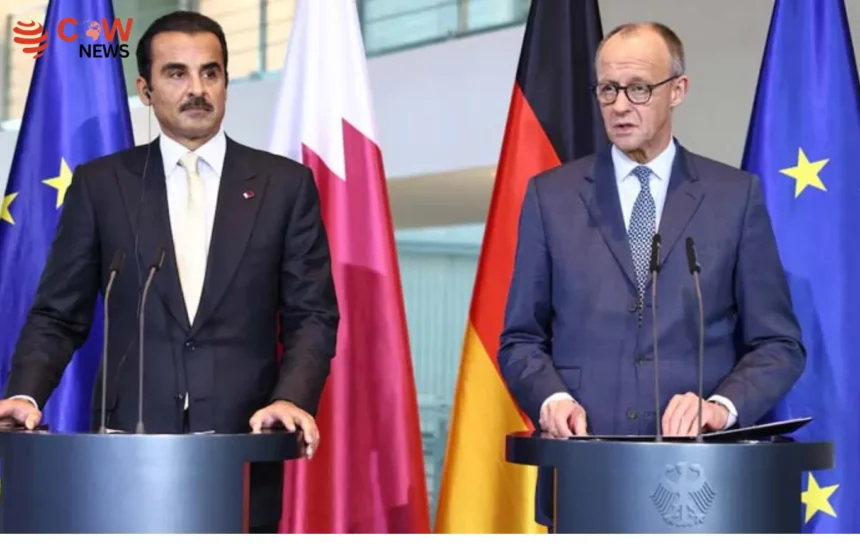
Berlin (The COW News Digital) Qatar and Germany have called on Iran to meet its international nuclear obligations, increase transparency over its nuclear programme and end its military support for Yemen’s Houthi movement, according to a joint declaration issued during the Qatari Emir’s state visit to Germany.
The two countries urged Tehran to fulfil its responsibilities under the Treaty on the Non-Proliferation of Nuclear Weapons (NPT) and its Comprehensive Safeguards Agreement with the International Atomic Energy Agency (IAEA).
They also called on Iran to resume full cooperation with the UN nuclear watchdog to provide assurances that its nuclear programme is intended for peaceful purposes.
The declaration stressed that Iran must never develop or acquire nuclear weapons. Qatar and Germany further highlighted the need to address regional security concerns linked to the use of ballistic missiles.
The joint statement also raised concerns about threats to international shipping and maritime trade.
Qatar and Germany strongly condemned Iranian attacks and threats targeting commercial vessels, while rejecting any action that could result in the closure of the Strait of Hormuz or restrict freedom of navigation.
Both countries emphasised that international trade routes must remain open, free and accessible without restrictions or additional charges.
They also reaffirmed their commitment to international maritime law, including the relevant provisions of the United Nations Convention on the Law of the Sea and the regulations of the International Maritime Organization.
The declaration described the uninterrupted movement of commercial shipping as essential to international trade and economic stability.
Yemen’s ongoing conflict was another major issue addressed in the joint declaration.
Qatar and Germany strongly condemned continued attacks carried out by the Houthi movement in Yemen and against Saudi Arabia.
They expressed solidarity with the internationally recognised Yemeni government and the Kingdom of Saudi Arabia, calling on the Houthis to immediately stop military operations, threats and attacks against civilian shipping.
Both countries also urged the Houthi movement to return to the political process in good faith.
A central demand was directed at Tehran, with the two governments calling on Iran to stop supplying weapons to the Houthis and end its broader support for the group.
They reaffirmed their commitment to Yemen’s unity, sovereignty, independence and territorial integrity.
The statement also reiterated support for United Nations Special Envoy Hans Grundberg and his efforts to secure an inclusive political settlement led by Yemenis.
The declaration reflects shared concerns between Qatar and Germany over escalating tensions in the Middle East, particularly the security of maritime routes, nuclear proliferation and the activities of armed groups across the region.
Both countries maintained that diplomacy and dialogue should remain the primary means of resolving international disputes and achieving lasting stability.
The joint position was announced during the state visit of Qatar’s Emir, Sheikh Tamim bin Hamad Al Thani, to Germany on November 20, 2026.
The visit also provided an opportunity for the two countries to discuss wider political, security and economic cooperation.
Their statement places renewed diplomatic pressure on Iran over its nuclear commitments, maritime security and involvement in regional conflicts, while emphasising the importance of international cooperation to prevent further escalation.