

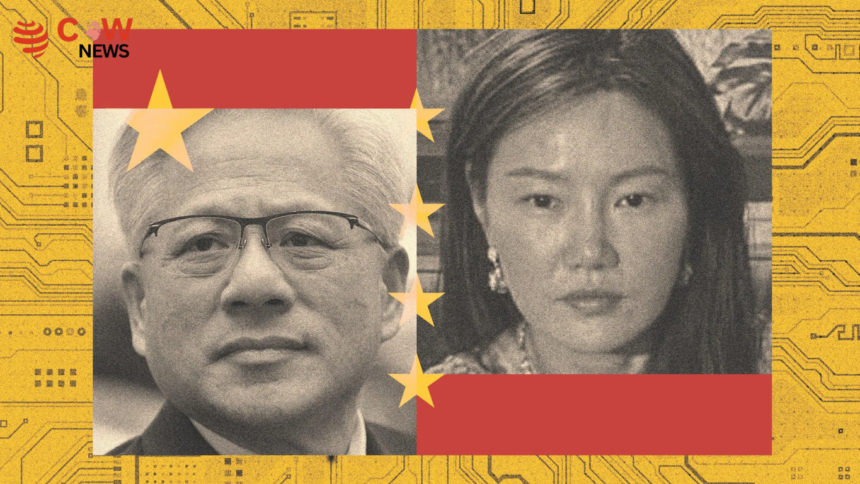
WASHINGTON / SINGAPORE(The COW News Digital) Nvidia is facing growing scrutiny over its international business relationships after reports concerning chief executive Jensen Huang’s alleged personal relationship with a Chinese technology entrepreneur raised fresh questions about the security of the company’s advanced artificial intelligence chips.
The controversy has attracted attention in Washington and the global technology industry because Nvidia’s processors are considered essential to the development of modern artificial intelligence systems. These powerful computing chips are used by technology companies, research institutions and military organisations to develop increasingly sophisticated AI capabilities.
At the centre of the controversy is Alice Huang, a Chinese businesswoman associated with Singapore-based technology company Megaspeed. Reports have raised questions about her connections in China, the company’s business relationships and whether its access to Nvidia hardware could have created opportunities for Chinese companies to obtain computing resources restricted under American export regulations.
The allegations have not been established as proven wrongdoing. Megaspeed has denied violating export restrictions, while Nvidia has previously said that its compliance checks found no evidence of illegal activity.
Nevertheless, the developments have prompted renewed attention to the increasingly complicated relationship between commercial technology, international investment and national security.
Personal Controversy Becomes a Corporate Security Issue
Jensen Huang, one of the most influential figures in the global technology industry, has built Nvidia into a dominant supplier of processors used to train and operate artificial intelligence systems.
Reports published in November 2026 alleged that Huang had been involved in an extramarital relationship with Alice Huang, who is not related to him. The reports subsequently developed into a wider discussion about possible connections between the businesswoman, her technology company and Chinese commercial interests.
Huang reportedly acknowledged being unfaithful to his wife, Lori Huang, following the allegations.
However, the personal controversy has become particularly significant because of the strategic importance of Nvidia’s products and the sensitivity surrounding their international distribution.
Nvidia’s board has reportedly initiated an examination of the circumstances surrounding the relationship and the company’s dealings with Megaspeed. One of the central questions is whether any corporate information, confidential technology or commercially sensitive material could have been exposed.
The board has indicated that Huang will remain in his position while the matter is examined.
There is currently no established public evidence demonstrating that Nvidia’s technology secrets were transferred to the Chinese government or that Huang knowingly assisted any foreign intelligence operation.
The distinction between allegations, corporate investigations and confirmed violations remains important as the controversy develops.
Why Nvidia’s Technology Matters to Global Security
Nvidia occupies a central position in the artificial intelligence industry because its graphics processing units, commonly known as GPUs, provide the computing power required for advanced AI development.
Unlike conventional computer processors, these specialised chips can perform enormous numbers of calculations simultaneously. This makes them particularly useful for training large language models, analysing complex information and operating sophisticated machine-learning applications.
Leading AI developers rely on high-performance computing infrastructure to build products capable of generating text, analysing images, writing computer code and processing large amounts of information.
Nvidia hardware is also relevant to defence applications, including intelligence analysis, military simulations, autonomous systems and other advanced technologies.
For this reason, access to high-performance processors has become an important element of the technological competition between the United States and China.
Washington has introduced restrictions intended to prevent certain advanced American semiconductor products and related technologies from reaching Chinese organisations that could use them for sensitive military or strategic purposes.
These restrictions have created significant challenges for Chinese technology companies seeking access to the most powerful computing equipment.
As a result, the international market for AI processors is no longer viewed simply as a commercial industry. It has increasingly become part of wider discussions about economic competitiveness, technological independence and national security.
Megaspeed’s Growing Role in the AI Computing Market
Megaspeed, a Singapore-based technology business, has attracted attention because of its reported purchases of large quantities of Nvidia processors.
The company operates data-centre infrastructure and provides computing capacity to other organisations. Rather than every customer purchasing expensive processors and building its own facilities, businesses can rent access to computing resources through cloud-based services.
This business model has become increasingly important as demand for AI computing continues to grow.
According to the reports, Megaspeed has become one of Nvidia’s largest customers in Southeast Asia, purchasing substantial quantities of advanced processors for its data-centre operations.
The company subsequently provides computing services to other customers, including major technology businesses.
One of the names mentioned in connection with these arrangements is Alibaba, the Chinese technology group that operates major cloud computing services and develops artificial intelligence models.
Alibaba’s involvement has attracted attention because the company is among China’s most prominent technology organisations and has invested heavily in developing domestic AI capabilities.
Its Qwen family of artificial intelligence models has become an important part of China’s expanding AI ecosystem.
The central question being examined is whether overseas computing facilities could potentially provide Chinese businesses with access to advanced Nvidia processors that they might otherwise struggle to obtain directly.
However, renting computing capacity through an overseas provider is not automatically illegal under American export regulations. The legal position depends on several factors, including the identity of the customer, the ownership and control of the infrastructure, the intended use of the technology and whether the arrangement violates applicable restrictions.
How Export Restrictions Could Be Circumvented
American export controls are designed to regulate the international movement of certain advanced technologies.
In the semiconductor industry, these rules can apply not only to physical shipments of processors but also to particular transactions, end users and other arrangements involving restricted technology.
One concern raised by investigators is the possibility that companies operating outside China could purchase advanced processors and subsequently provide computing services to Chinese customers.
Such arrangements can create difficult compliance questions.
For example, an overseas data-centre operator may purchase legally available hardware for its own business operations. It may then sell computing services to customers in different countries.
If the arrangement involves a prohibited end user, restricted ownership structure or transaction designed to evade export regulations, it could raise serious legal concerns.
The important issue is whether a company is genuinely operating an independent international computing business or acting on behalf of a restricted customer.
Reports have suggested that American authorities examined whether Megaspeed could have diverted some Nvidia processors to Chinese interests in violation of export restrictions.
The company has denied such allegations and maintained that its operations comply with applicable laws.
Nvidia has also stated that its own compliance procedures did not identify evidence of illegal activity involving the company.
Consequently, questions surrounding Megaspeed’s business model should not be confused with proof that prohibited chip transfers actually occurred.
Questions Surrounding Chinese Financial Connections
Another aspect of the controversy concerns the reported financial relationships between Megaspeed and Chinese technology investors.
New York-based research firm Culper Research raised questions about the company’s ownership and funding arrangements in a report published earlier in 2026.
The research firm alleged that Megaspeed appeared to have received substantial financial backing from Alibaba through a network of companies.
Its analysis suggested that the financing arrangements could indicate closer commercial connections between the Singaporean business and Chinese technology interests than its corporate structure might initially suggest.
These claims have not been independently established as proof of illegal ownership or prohibited transactions.
Nvidia has reportedly maintained that Megaspeed is not owned by a Chinese parent company.
However, questions remain about whether corporate ownership alone provides a complete picture of the financial relationships behind a major technology business.
International companies can receive funding from investors located in different countries without necessarily becoming subsidiaries of those investors.
Nevertheless, significant financial dependence, operational influence or undisclosed control arrangements may become relevant when assessing compliance with sensitive export regulations.
The issue is therefore not simply where a company is registered but who finances it, who makes important decisions and how its technology and services are ultimately used.
Singapore’s Growing Importance in Nvidia’s Business
Singapore has become an increasingly important location for international technology companies because of its developed financial system, business infrastructure and position as a regional technology centre.
Its data-centre industry has expanded as global demand for cloud computing and AI services has increased.
The country is also an important gateway for companies seeking to serve customers across Southeast Asia and other international markets.
Nvidia’s reported sales figures have highlighted the growing importance of Singapore-registered businesses in its international operations.
According to figures discussed in the reports, companies registered in Singapore represented more than one-fifth of Nvidia’s sales during the first half of the previous year, compared with less than 10 per cent two years earlier.
However, geographical sales reporting does not necessarily establish where processors are ultimately delivered or which organisations eventually use the computing capacity.
Nvidia has previously explained that its accounting and reporting methods distinguish between the location of customers and the final destination of its products.
The company has reportedly stated that actual shipments to Singapore accounted for a much smaller proportion of its overall revenue than the headline sales figures might suggest.
This distinction has become important because regulators increasingly want to understand the final destination and end users of advanced semiconductor products.
Investigations and Previous Concerns
Questions about Megaspeed’s connections and business activities reportedly emerged before the latest controversy involving Jensen Huang.
According to the reports, American officials examined whether some of the company’s Nvidia processors could have been redirected to China in breach of export regulations.
The company has also reportedly faced scrutiny from authorities in Singapore.
Megaspeed has rejected accusations of wrongdoing, saying that its business activities comply with relevant regulations and that previous investigations did not establish violations.
A separate investigation by Bloomberg reportedly identified a Chinese business with similarities to Megaspeed, including comparable presentation materials and a website that closely resembled the Singaporean company’s online presence.
Such similarities can attract regulatory attention, particularly when companies operate across borders in strategically sensitive industries.
However, similarities between websites or business presentations do not independently establish common ownership, intelligence connections or unlawful conduct.
The Financial Times also previously reported that Alice Huang had approached Chinese investors regarding the development of a data centre in Southeast Asia.
These developments have added to questions about the company’s commercial relationships and whether its activities received sufficient scrutiny.
The Alleged Intelligence Connection
Perhaps the most sensitive element of the story concerns allegations that Alice Huang may have connections to Chinese state interests.
Reports have highlighted her previous professional experience, including work associated with China’s state broadcaster CCTV and HSBC, before she became involved in the technology sector.
Some reports have described her as a suspected Chinese intelligence-linked individual.
However, an allegation of intelligence involvement is extremely serious and requires credible supporting evidence. Employment history, nationality, business relationships or personal associations cannot independently establish that someone works for a foreign intelligence agency.
No publicly established evidence presented in the supplied reporting proves that Alice Huang acted as a Chinese intelligence operative or used her relationship with Jensen Huang to obtain restricted technology.
The possibility of national security concerns has nevertheless become part of the wider examination because of the strategic significance of Nvidia’s business and the questions surrounding Megaspeed.
Corporate investigations are likely to focus on whether appropriate checks were conducted, whether business decisions followed established compliance procedures and whether confidential information was exposed.
For Nvidia, the issue is not limited to one business relationship. It also concerns the effectiveness of the company’s internal systems for assessing customers and monitoring the eventual use of its technology.
Jensen Huang’s Position on China
The controversy has also brought renewed attention to Jensen Huang’s public views on American technology policy towards China.
Huang has repeatedly argued that restricting American semiconductor companies from selling to China could weaken their international competitiveness.
He has maintained that the United States should remain commercially engaged in one of the world’s largest technology markets rather than surrendering business opportunities to competitors.
In previous public remarks, Huang described America’s export-control strategy as unsuccessful, arguing that restrictions had significantly reduced Nvidia’s market share in China.
He has also warned that excluding Chinese customers could encourage the development of domestic alternatives and reduce the influence of American technology companies.
His position reflects a broader debate within the US technology industry.
Some business leaders believe that maintaining commercial access to international markets helps American companies remain competitive and financially supports further research and development.
Others argue that advanced semiconductor technology is too important to national security to be distributed without strict limitations.
The disagreement illustrates the challenge facing policymakers: protecting sensitive technology while preserving the commercial advantages of American companies.
Huang’s comments about China do not, by themselves, establish any connection to the allegations involving Megaspeed.
Washington’s Difficult Balancing Act
The United States faces a complicated challenge in regulating the international semiconductor market.
On one hand, American authorities want to prevent sensitive technologies from reaching organisations that could use them for military or strategic purposes.
On the other hand, semiconductor companies operate in a highly competitive international environment in which research, manufacturing, investment and sales depend on global commercial relationships.
Excessively restrictive policies could encourage foreign competitors to develop alternative technologies and reduce the influence of American companies.
However, insufficient oversight could create opportunities for restricted organisations to access computing resources through complicated international arrangements.
This is particularly relevant to AI because access to advanced computing infrastructure can influence the speed and scale at which companies develop sophisticated models.
The controversy surrounding Megaspeed has therefore highlighted the importance of effective customer verification, transparent ownership arrangements and monitoring of end users.
It has also raised questions about whether existing export-control systems are sufficiently equipped to deal with cloud computing and international data-centre operations.
What the Investigation Could Mean for Nvidia
Nvidia’s position as a leading supplier of AI processors makes corporate governance and regulatory compliance especially important.
The company’s relationships with major customers are subject to increasing attention from investors, regulators and policymakers.
If the investigation identifies weaknesses in customer screening or internal oversight, Nvidia could face pressure to strengthen its compliance procedures.
Potential consequences could include more extensive customer verification, additional checks on overseas data-centre operators and closer monitoring of companies providing computing services to international clients.
The controversy could also influence how investors assess the risks associated with Nvidia’s international business.
The company has become one of the most valuable technology businesses in the world, supported by strong demand for AI infrastructure.
Any uncertainty surrounding its export compliance, customer relationships or corporate governance could therefore attract attention from financial markets.
However, there is currently no confirmed basis for concluding that the allegations will result in regulatory penalties or a major change in Nvidia’s leadership.
The board’s reported decision to retain Huang during the examination suggests that the company has not announced an immediate leadership change.
The Wider Battle for Artificial Intelligence Leadership
The controversy comes at a time when the United States and China are competing to establish leadership in artificial intelligence.
Both countries recognise that advanced AI could influence future economic growth, scientific research, industrial productivity and military capabilities.
American technology companies currently play a major role in supplying the processors and infrastructure used by leading AI developers.
China, meanwhile, has invested heavily in domestic semiconductor production, data centres and AI research.
Chinese companies have continued to introduce new AI models designed to compete with international products, including systems that focus on lower operating costs and improved computing efficiency.
The expansion of China’s domestic AI industry has strengthened the country’s determination to reduce its dependence on foreign semiconductor suppliers.
At the same time, access to advanced processors remains an important consideration for companies seeking to develop increasingly powerful AI systems.
This is why questions surrounding the international distribution of Nvidia chips have become politically sensitive.
The debate is no longer simply about commercial sales. It also involves technological independence, economic competition and the future balance of power in the global AI industry.
What Happens Next?
The immediate focus is expected to remain on the investigations surrounding Megaspeed, its financial relationships and its access to Nvidia technology.
Nvidia’s board will also face questions about the effectiveness of its internal compliance procedures and whether its business relationships were adequately reviewed.
For regulators, the central issue will be whether any export restrictions were breached and whether restricted organisations obtained access to technology through overseas intermediaries.
Megaspeed has denied wrongdoing, and Nvidia has said its checks found no evidence of illegal activity.
Similarly, allegations concerning Alice Huang’s possible intelligence connections remain unproven based on the information available in the reports.
The outcome of the investigations will be important in determining whether the controversy represents a corporate governance issue, a regulatory compliance concern or a more significant national security matter.
For now, the case illustrates how personal controversies, international business relationships and strategic technology can become closely connected in an increasingly competitive global environment.
As artificial intelligence becomes more important to economic and national security, governments and technology companies are likely to face growing pressure to ensure that advanced computing resources are distributed responsibly.
The developments surrounding Nvidia may therefore become part of a much larger debate over who controls the technology that will shape the next generation of artificial intelligence.