
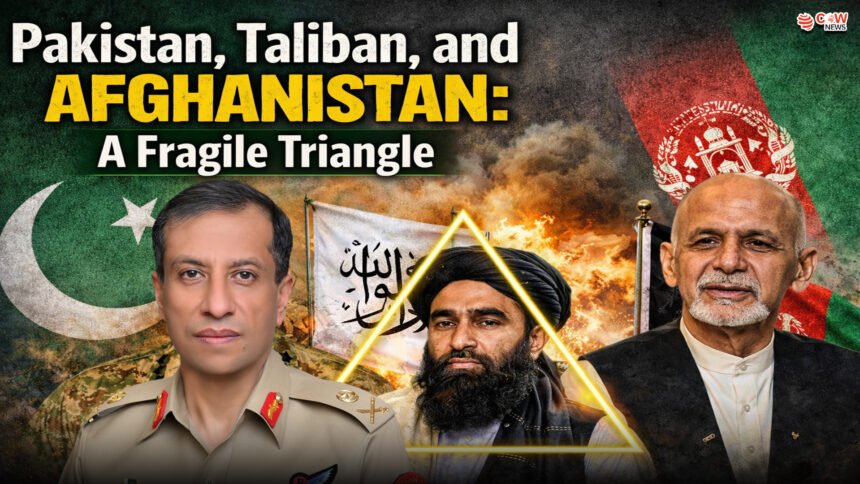
The ongoing clashes between the Pakistani military and certain Taliban factions may temporarily benefit the Afghan public by weakening the unpopular Taliban. However, it could also create a power vacuum that allows other anti-Pakistan groups to consolidate control over Kabul.
For normal bilateral relations and lasting peace, Afghanistan must recognize the Durand Line as an international border and sincerely acknowledge Pakistan as a sovereign state. Simultaneously, Afghanistan must ensure that its territory is free from anti-Pakistan elements and their operations. Pakistan, on the other hand, must abandon its policies of treating Afghanistan as an extension of itself, stop establishing puppet regimes, and permanently discard ill-conceived strategies like “strategic depth.”
Though ethnically Pashtun, the Taliban do not represent the majority of the Afghan population. Of Afghanistan’s approximately 4.75 million people, Pashtuns constitute 40–45%, while non-Pashtun ethnic groups—Tajiks (27–30%), Hazaras (10%), Uzbeks (9–10%), and smaller communities including Turkmen and Baloch—make up the remaining 50–55%. Interestingly, Tajiks in Afghanistan outnumber the population of neighboring Tajikistan.
A significant portion of Pashtuns oppose the Taliban and their extremist ideology. Yet Pakistan has twice installed the Taliban as a puppet authority in Afghanistan by force, and today Pakistan is facing the consequences.
Before Pakistan’s independence, the region now known as Khyber Pakhtunkhwa held a referendum to join either India or Pakistan. Despite opposition from the provincial government led by the Khudai Khidmatgar movement and support from the Indian National Congress, the majority voted to join Pakistan. Soon after, Governor-General Muhammad Ali Jinnah dismissed the Congress-affiliated provincial government, angering Pashtun nationalists. Afghanistan leveraged this discontent to support the Pashtunistan movement, particularly during the 1960s and 1970s under President Sardar Daud Khan, providing shelter to activists from Khyber Pakhtunkhwa and Balochistan seeking to unite Pashtuns.
In 1980, Pakistan, under U.S. and Saudi guidance, launched the Afghan jihad project, which funded madrassas and promoted religious militancy to counter Pashtun nationalism. Influential commanders and groups such as Gulbuddin Hekmatyar were supported to weaken ethnic separatism. Later, in 1994, Pakistan played a central role in creating the Taliban, trained in religious schools like Darul Uloom Haqqania in Akora Khattak, Khyber Pakhtunkhwa—allegedly the same institution linked to the assassination of Benazir Bhutto. The Afghan public perceives the Taliban as a Pakistani product, yet today, the Taliban are using the Pashtun card against Pakistan.
Non-Pashtun groups in Afghanistan also strongly reject the Taliban. Historically, Sardar Daud Khan’s government implemented policies to shift demographics in favor of Pashtuns in Tajik, Uzbek, and Hazara-majority areas. This created deep resentment, and many non-Pashtun groups, feeling marginalized and insecure, formed political movements—sometimes armed—against Pashtun dominance. During the Afghan jihad, Pakistan again supported Pashtun militants, culminating in attempts to install commanders like Hekmatyar and later the Taliban to secure influence in Kabul.
Today, both non-Pashtun communities and many Pashtuns oppose the Taliban due to their extremist ideology, treatment of women, and heavy-handed enforcement of conservative Islamic practices, blaming Pakistan for their rise.
The Taliban’s unrepresentative, non-elected government—imposed with Pakistan’s support—further fuels Afghan resentment. While Pakistan’s former Prime Minister praised the Taliban as liberators, the current leadership under Army Chief General Asim Munir has rejected policies of previous generals who nurtured the Taliban. Pakistan’s military is now confronting the very proxies it once created and supported.
In propaganda campaigns, Taliban factions label Pakistan’s army as “Punjabi forces” while simultaneously attacking Pakistan to attract domestic and international anti-Pakistan support. India openly backs the Taliban, while Israel may operate indirectly through intermediaries like the UAE or Qatar. Notably, before recent Taliban attacks in Pakistan, the Israeli lobby in the UK intensified diplomatic pressure, including efforts by lobbyists like Zach Goldsmith, leveraging personal and political narratives related to Pakistan’s leadership.
The ongoing clashes could reduce Taliban unpopularity among Afghans temporarily. Pakistan-haters may support the Taliban as a counterbalance. Conversely, the conflict may empower groups hostile to both Pakistan and the Taliban, creating an Afghan government that is potentially anti-Pakistan, even if less extremist. Thus, whether the Taliban win or lose, Pakistan faces complex strategic and political challenges.
Sheraz akram paracha