
Chitral — (The Cow new digital) In the remote northern region of Pakistan, the Kalash Valley stands out for its unique cultural traditions, where death is not observed as a moment of mourning but rather as a celebration of life. For the indigenous Kalash community, death is considered a transition to a new existence, and is marked with festive rituals instead of sorrowful grieving.
The community believes that the deceased has been freed from the hardships of earthly life and has embarked on a peaceful journey to reunite with ancestors. Based on this belief, funerals are observed in a distinctly celebratory manner, reflecting joy rather than grief.
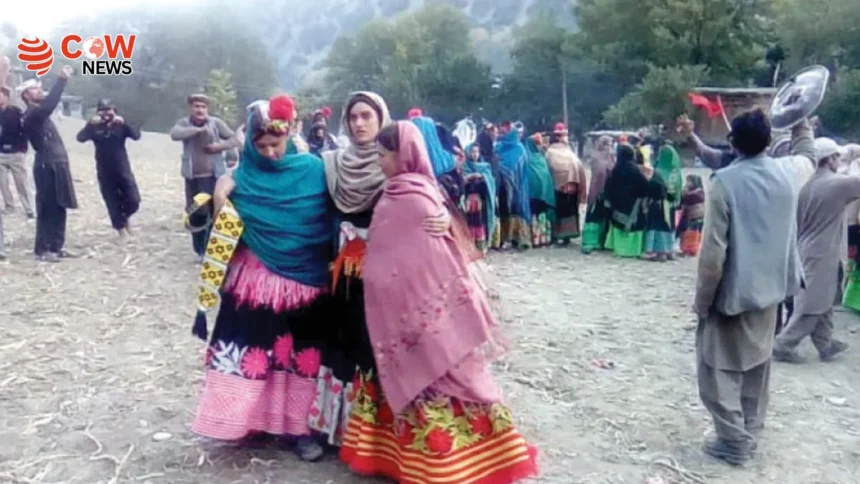
According to local traditions, upon the death of a community member, mourning is replaced by three days of music, dance, and cultural festivities. The deceased is placed in a communal hall, locally known as a “Jasta Khan,” where people gather to perform traditional dances called “Palay,” accompanied by rhythmic drumbeats and music.
During these ceremonies, the community collectively participates in a ritual known as “Shrooga,” in which 30 to 40 goats are sacrificed. This practice is not only symbolic but also serves as a form of social support, ensuring that the grieving family receives financial and emotional assistance from the community.
While close family members do express sorrow and tears, the overall atmosphere remains a blend of grief and celebration, which researchers describe as a rare cultural fusion of emotions.
Historical studies conducted between 2022 and 2025 suggest that in the past, bodies were placed in open wooden coffins. However, due to population growth and increasing interaction with nearby Muslim communities, burial practices have gradually become more common.
During burial rituals, personal belongings such as fruits, money, and other items are placed with the deceased to symbolize their life journey. In some cases, a wooden statue known as a “Gandao” is also placed alongside the body, representing the identity of the deceased. However, this tradition has been gradually fading over time.
The Kalash Valley continues to attract global attention for preserving one of the world’s most distinctive cultural approaches to life and death, blending spirituality, community bonding, and ancient traditions.