

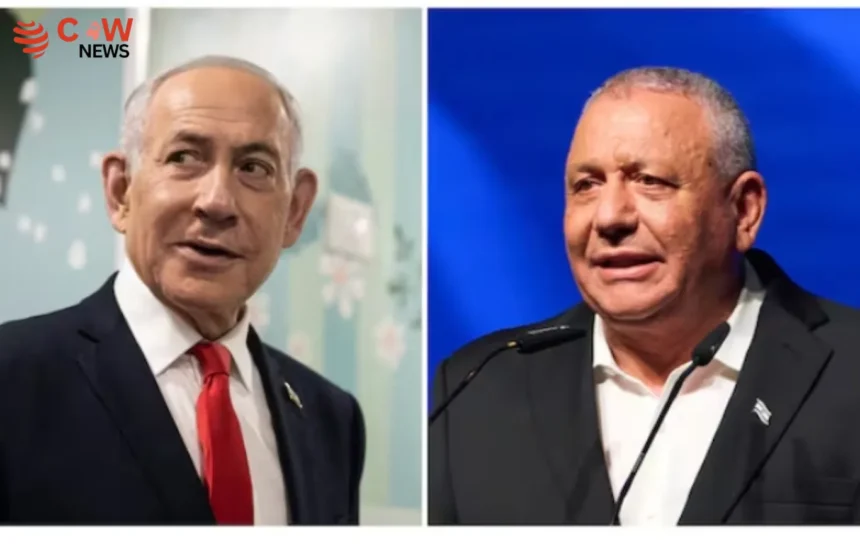
JERUSALEM (The COW News Digital) Israeli opposition leader and prime ministerial candidate Gadi Eisenkot has rejected Prime Minister Benjamin Netanyahu’s proposal to establish a national unity government, describing the offer as a political manoeuvre aimed at complicating the formation of a new administration.
According to Arab media reports, Eisenkot dismissed Netanyahu’s invitation, arguing that the outgoing prime minister was attempting to create obstacles for the incoming government rather than genuinely seeking political cooperation.
Eisenkot said Netanyahu was aware that he had lost the elections and was using the unity government proposal as a strategy to make the formation of a new government more difficult.
He maintained that such political tactics would not influence him or the Israeli public.
The rejection follows Netanyahu’s renewed appeal to opposition parties a day earlier, proposing the formation of a national unity administration in response to what he described as the Iranian threat.
Under the proposal, Netanyahu suggested forming a government that would include only Jewish political parties, presenting national security and confronting Iran as the central objectives of the proposed arrangement.
However, Eisenkot has refused to support the initiative, signalling that the opposition intends to pursue its own efforts to establish a new government.
The political development comes after Israel’s recent elections, which have reshaped the country’s parliamentary balance and opened the way for a possible change in leadership.
According to the reported election outcome, Eisenkot secured the support of 67 members of the Knesset, Israel’s parliament, and was subsequently assigned the responsibility of forming the next government by the Israeli president.
The parliamentary backing places Eisenkot in a position to negotiate the formation of a new governing coalition, although the process could involve further political negotiations among different parties.
Netanyahu’s proposed unity arrangement appears to have failed to secure the support of the opposition leader, adding another challenge to the country’s ongoing political transition.
The latest disagreement highlights the deep divisions between Israel’s political leadership and opposition at a time when national security, relations with Iran and the future direction of government policy remain central issues.
Further negotiations are expected as Eisenkot works to establish a government backed by the parliamentary majority.